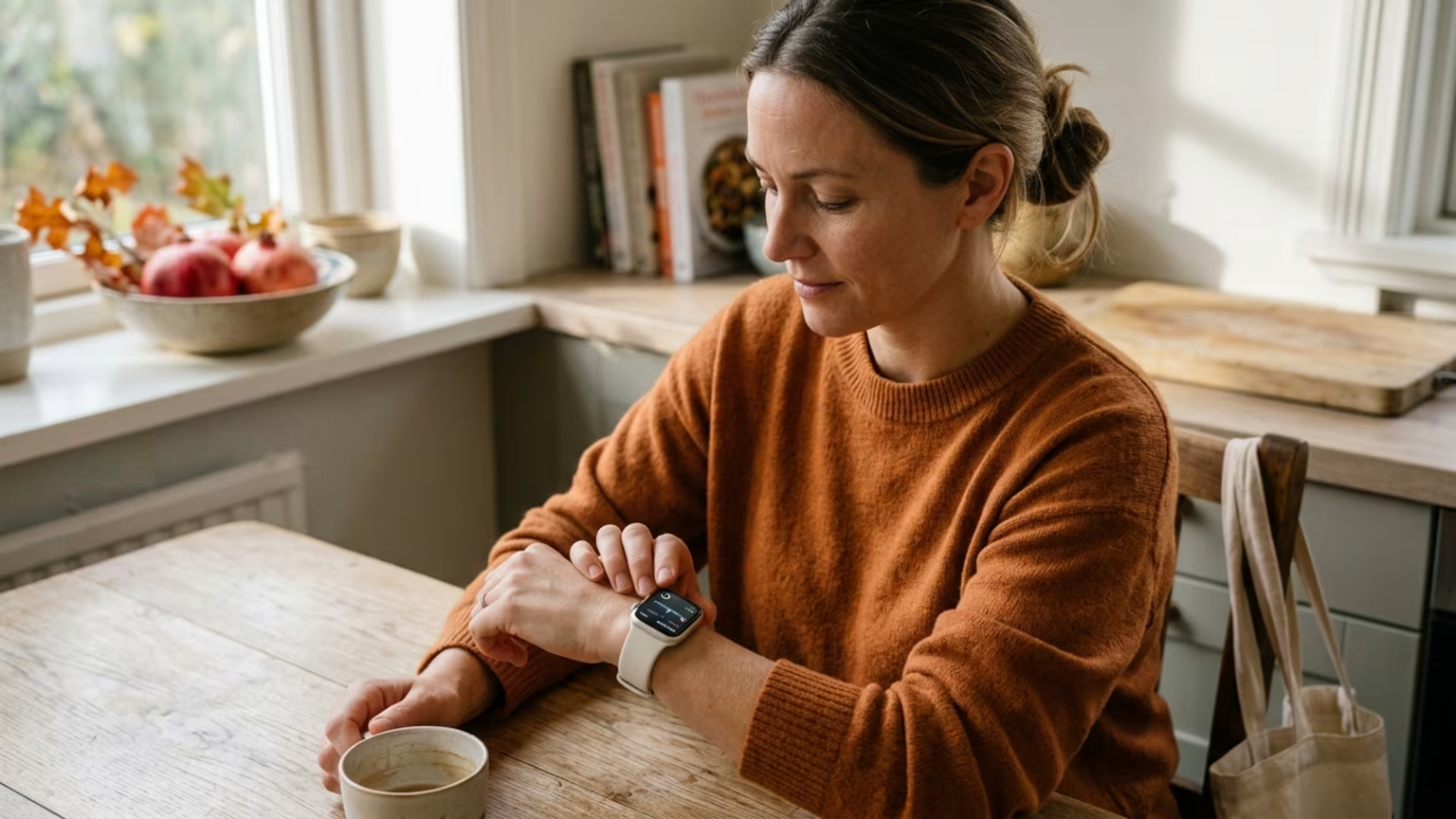

On September 11, 2026, Apple introduced a Health Age metric for the Apple Watch. Learn how this feature integrates movement, sleep and metabolic markers.





On September 11, 2026, Longevity.Technology reported that Apple is introducing a new Health Age feature for its wearable devices. The update arrives alongside the Apple Watch Series 12 and Apple Watch Ultra 4, utilizing an updated health-sensing system. This tool estimates how selected health metrics track relative to a user's chronological age. It appears within a new Longevity area of the Health app to present health data longitudinally.
The Health app’s redesigned Insights area summarizes trends in heart tracking, sleep, fitness, vitals and readiness. Apple’s product page says the redesigned Health app is scheduled for late 2026. However, Longevity.Technology notes the feature rollout begins with watchOS 27 on September 14. This shift places body-weight goals alongside cardiovascular fitness, recovery and sleep tracking. It represents a significant step in consumer technology treating metabolic health as a comprehensive ecosystem.
The Longevity view combines several distinct categories of human biology. Longevity.Technology reports that it brings together data from heart health, sleep, movement and metabolic health. It also integrates mental wellbeing, hearing and nutrition tracking. This combination shifts the focus away from superficial vanity metrics toward holistic biological function.
Reported Health Age inputs include VO2 max, resting heart rate, sleep quality and heart-rate variability. Users can also add laboratory results such as A1c and LDL cholesterol. By allowing users to input specific blood markers, the system bridges the gap between daily habits and clinical diagnostics. The updated sensor system reportedly enables heart-rate readings every five seconds.
The new sensors capture heart-rate variability readings approximately every five minutes. Longevity.Technology describes this as a 24-fold increase in sampling frequency compared with earlier Apple Watch sensing. Apple separates this variability into short-term recovery and slower-changing overall trends, according to the report. This detailed cardiovascular monitoring offers a window into how your body manages daily physiological demands.
For years, I watched smart, capable people blame themselves when standard diet advice failed them. They would cut calories drastically, run themselves into the ground and inevitably regain the weight. It was heartbreaking to see. I realized we were treating a complex biological and psychological system like a simple math problem.
That was the turning point when I knew we had to focus on metabolic health and habits rather than just restriction. By integrating diverse biomarkers, the new wearable approach aligns with that exact philosophy. It allows adults to monitor how a sustainable movement routine influences resting heart rate over time. Apple vice president of Health and Fitness Dr. Sumbul Desai said the company aims to provide actionable, science-based insights.
Apple describes Health Age as providing insights into longevity. However, Longevity.Technology reports that these features do not treat or diagnose medical conditions. Apple’s Vitals app is intended strictly for wellness rather than medical use. A favorable or unfavorable Health Age result is not a clinical assessment of metabolic disease, cardiovascular risk or biological aging.
The scoring formula remains completely private in the available sources. Apple’s product page does not disclose the scoring formula, the weighting of inputs or complete compatibility requirements. Without those details, users cannot know how a change in sleep, VO2 max or A1c materially affects the result. A single composite number can easily conceal important differences in your underlying biological systems.
A composite score might obscure whether your main opportunity is better aerobic fitness, more consistent activity or clinical attention to a laboratory result. Overnight wear also presents a significant practical limitation for these recovery features. Longevity.Technology editor-in-chief Phil Newman identifies overnight charging as a challenge for capturing continuous data. Newman notes that missing overnight sleep and recovery data weakens the usefulness of the longitudinal view.
Continuous data collection is crucial for understanding how sleep regularity impacts metabolic health. If the watch is removed during charging, it lacks the data needed to produce a meaningful picture. Newman suggests that users may need to top up the battery multiple times daily. Alternatively, they might need an additional charging solution to maintain continuous coverage.
A missing night of tracking should not be interpreted as poor recovery. Users should be extremely cautious about making training or nutrition decisions from incomplete data. Newman says he charges his Apple Watch overnight and instead uses a continuously worn Whoop device to track recovery. Avoid using the Health Age metric to justify compensatory exercise, because no evidence in the available coverage validates it for determining training loads.
Nutrition and body composition also lack clear operational parameters in this update. Although nutrition and metabolic health are included in the Longevity view, the sources do not specify exact targets. They do not outline calorie recommendations, body-composition measurements or methods for distinguishing fat loss from muscle loss. Managing weight requires understanding multiple variables, including appetite, nutrition, movement and sleep.
Apple’s health-sensing claims are partly supported by a company-commissioned study. This research involved more than 1,000 participants and compared the new heart-sensing system with competing wearables. However, the available report does not provide the study’s numerical accuracy results, full methodology or independent peer review. An accurate heart sensor does not automatically produce an accurate Health Age estimate.
The company is also introducing a Readiness score ranging from 0 to 10. This metric evaluates recent activity, vital signs and sleep to gauge daily physical capacity. It provides plain-language guidance such as "Recover," "Pace yourself," "Ready" and "Go for it." Readiness is a daily recovery-oriented feature, whereas Health Age provides a longer-term longitudinal view.
Using readiness information can support flexible and sustainable training decisions. A lower-readiness day may be an opportunity for easier activity or mobility work rather than a reason to abandon exercise entirely. This approach helps active adults prevent the burnout often associated with rigid, high-intensity workout schedules. Prioritizing recovery allows the body to repair tissue and adapt to previous training sessions effectively.
The Health app reportedly supports at-home assessments of flexibility, balance and movement mechanics. These assessments use an iPhone camera, Apple Watch and on-device vision models developed with clinicians. For adults interested in strength training and aging, movement quality is highly relevant. However, the available sources do not state that Health Age directly measures muscle mass, maximal strength or progressive overload.
The arrival of these features raises questions about the practical utility of broad health dashboards. Longevity.Technology explicitly raises the question of whether Health Age will prompt meaningful action or simply become a fancier step counter. The available coverage does not cite a trial showing that this feature improves sustainable weight loss. There is no proof yet that it increases exercise adherence, strength-training consistency or long-term behavior change.
Future research is needed to determine if composite scores actually help adults maintain healthy daily routines. Until clear clinical data emerges, users should treat Health Age as a trend prompt rather than a definitive medical verdict. It is essential to review the underlying measures individually to understand your body. Look closely at your sleep patterns, resting heart rate, heart-rate variability and relevant laboratory data.
Use A1c, LDL cholesterol and other laboratory results as clinical information to discuss with a qualified healthcare professional. Do not assume that a lower body weight or a single improved metric automatically represents better long-term health. Keep strength training focused on observable performance markers such as consistency, exercise quality and gradual progression. Ultimately, the true value of any health technology lies in whether it encourages sustainable habits rather than a younger-looking number.
WeightRestart shares research-led guidance on weight loss, metabolism, nutrition, strength, appetite, sleep and recovery. Our goal is to make complex health information clear, practical and useful for people building progress they can maintain.






Learn how to build a weight-management approach around better information, realistic expectations and habits you can keep using.
read the blog