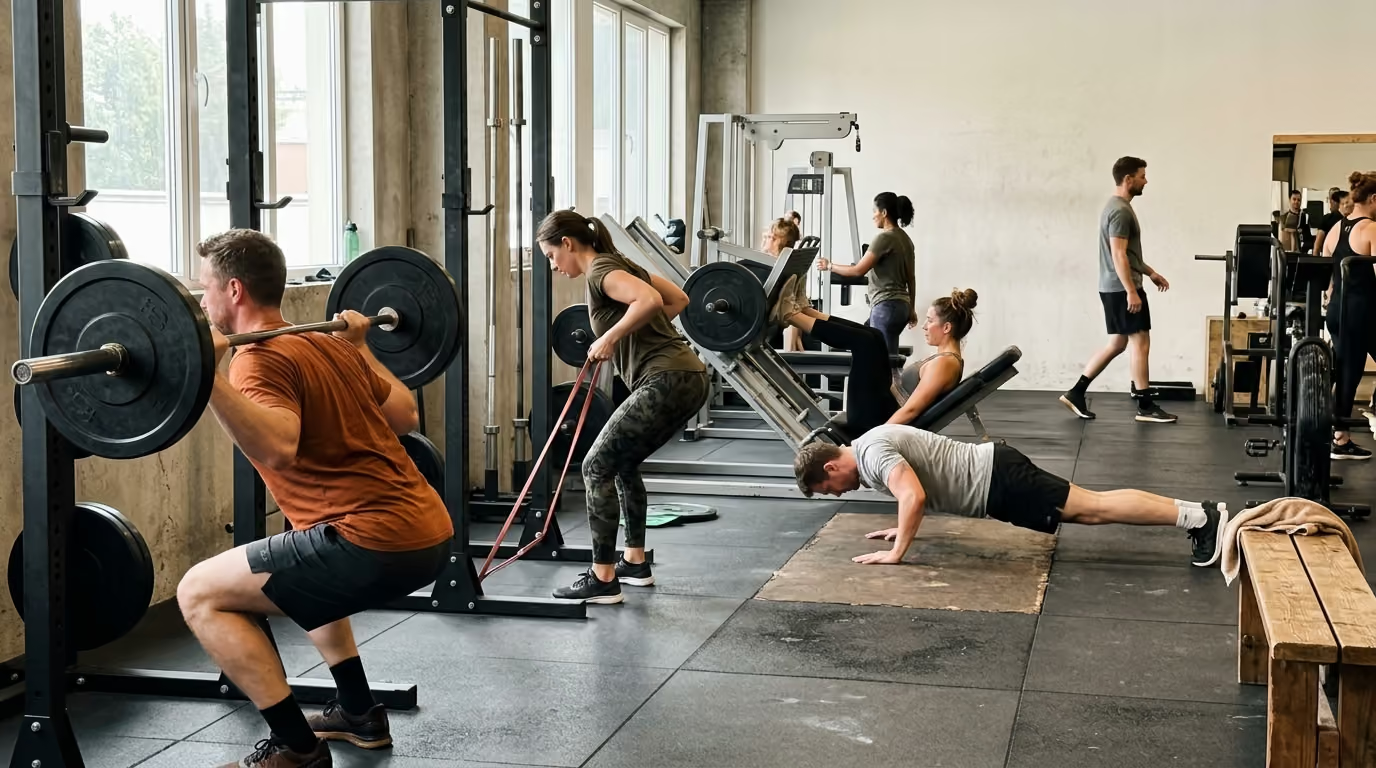

Optimal muscle growth and strength development come from matching the unique biomechanical benefits of free weights, machines, bands, and body weight to your personal fitness goals.





Many adults trying to improve their body composition search for a simple answer to a common question: which tool builds more muscle and strength, free weights, machines, bands, or body weight? The fitness industry often presents these tools as competing philosophies, claiming that one is inherently superior for burning energy, building functional strength, or preventing injury. The scientific reality is far more objective and practical.
Resistance training implements are simply different instruments for applying the universal rules of muscle physiology. Free weights, machines, cables, resistance bands, and body-weight exercises all stimulate muscular adaptation when they create sufficient mechanical tension through a meaningful range of motion. The optimal choice depends on your specific goals, joint structure, training environment, and personal preferences rather than an imaginary hierarchy of equipment.
At the cellular level, your skeletal muscle tissue cannot see the equipment you are holding. Muscle fibers respond to mechanical tension, which is the physical force generated when muscle proteins pull against an opposing load. Whether that load comes from gravity pulling down on iron, an elastic band stretching, or your own body mass resisting gravity, the intracellular signaling cascades that stimulate adaptation remain identical.
To initiate muscle growth and strength development, a training bout must recruit motor units and subject them to sufficient strain. The nervous system recruits motor units according to the size principle, activating smaller, fatigue-resistant units first before calling upon larger, high-threshold units as the movement demands more force or approaches fatigue. You can achieve this high level of recruitment with heavy absolute loads or with lighter loads moved with high effort close to muscular failure.
Progressive overload is the continuous driver of this process. Progressive overload means gradually increasing the physiological demand placed on the neuromuscular system over time. You can achieve this overload by adding external weight, performing more repetitions with a given load, improving movement execution, increasing the range of motion, or altering leverage to make an exercise mechanically harder.
The delivery system you select influences how easily you can apply these principles. Each modality alters how force is distributed across a joint, how much balance is required, and how straightforward it is to track weekly improvements. Understanding these underlying mechanics allows you to design an effective program in any training environment, from a commercial gym to a living room.
Every resistance tool interacts with human biomechanics through two primary factors: the resistance curve and stability demand. The resistance curve describes how the load changes throughout the range of motion of an exercise. Because human joints operate as lever systems, your capacity to produce force changes depending on joint angles and muscle lengths.
Free weights depend entirely on gravity, meaning the force vector always points directly downward toward the floor. The resistance experienced by your muscles changes based on the horizontal distance between the weight and the rotating joint axis, known as the moment arm. In a dumbbell lateral raise, the resistance is minimal at the bottom when the weight hangs next to your hip. The resistance peaks when your arm reaches horizontal, where the moment arm is longest.
Elastic resistance bands provide an ascending resistance curve governed by material deformation. As a band elongates, its internal tension rises, creating an exponential increase in resistance toward the end of the movement. Cable systems and specialized machines use cams and pulleys to alter force vectors. This allows equipment designers to match the resistance profile of the machine to the natural strength curve of human anatomy.
Stability demand refers to the active neuromuscular control required to keep the body and the implement on the intended path. Free weights require three-dimensional stabilization, forcing synergist muscles to prevent unwanted rotational and lateral movement. Machines constrain the path of motion along a fixed or semi-fixed track, which reduces the stabilization demand and allows you to direct all your effort into force production along a single plane.
Higher stability demand is neither inherently good nor bad. When your goal is to develop balance, whole-body coordination, and athletic transfer, high stability demands are beneficial. When your goal is isolated muscular hypertrophy or training safely around an injury, reducing stability demands allows you to challenge the target muscle without balance becoming the weak link.
Free weights represent the traditional benchmark of resistance training. Because barbells and dumbbells are unconstrained, they permit natural movement variations that accommodate individual differences in limb length and joint structure. They allow for precise, micro-loadable increments of external weight, making them ideal for long-term tracking of absolute strength.
Barbell training permits the highest absolute loads of any modality. Exercises such as squats, deadlifts, overhead presses, and bench presses place substantial axial loading on the skeleton, which provides a powerful stimulus for bone mineral density and systemic strength. Dumbbells and kettlebells introduce unilateral loading, which helps identify and resolve strength discrepancies between the left and right sides of the body.
The primary limitation of free weights is that technical proficiency and stabilizer fatigue can limit target muscle stimulation. In a barbell bent-over row, for instance, your lower back endurance, grip strength, or balance may give out before your upper back muscles reach a high level of fatigue. Free weights also require dedicated equipment, safety racks, and adequate floor space, which can make them less accessible for some home setups.
Resistance machines utilize weight stacks, guide rods, levers, and padded supports to guide the trainee through a predetermined movement path. These systems support the torso or limbs, minimizing the need for active postural stabilization. This allows you to focus your attention entirely on the contraction of the target muscle group.
Machines excel at managing fatigue and facilitating safe training near muscular failure. Because the weight stack is contained within a track, you can train to high levels of effort without the risk of dropping a heavy load on yourself. This makes machines valuable for older adults, individuals recovering from joint issues, and advanced lifters seeking high training volumes without excessive nervous system fatigue.
The main disadvantage of fixed-path machines is that they cannot adapt to every anatomical variation. If the pivot point of a machine does not align with your joint axis, the movement can cause joint discomfort. Strength developed on a machine also shows lower immediate transfer to unconstrained tasks, because your nervous system does not practice stabilizing the load in free space.
Cable stations occupy a functional middle ground between free weights and fixed machines. They use weight stacks connected through steel cables and adjustable pulleys, allowing you to alter the height, angle, and direction of resistance. Unlike free weights, which only pull straight down, cables can pull horizontally, diagonally, or upward.
This adjustable line of pull makes cables versatile for isolation exercises and rotational movements. Cables maintain continuous tension throughout a joint range of motion, even at positions where a dumbbell would lose its effective moment arm. For example, during a cable chest fly, tension remains high at the fully contracted position, whereas a dumbbell fly loses almost all mechanical tension at the top of the movement.
Cable systems require more stabilization than supported selectorized machines, but less whole-body coordination than heavy barbell lifts. Their main constraint is equipment accessibility. Multi-station cable towers are large and expensive, though compact wall-mounted units and functional trainers are becoming more common in home gym environments.
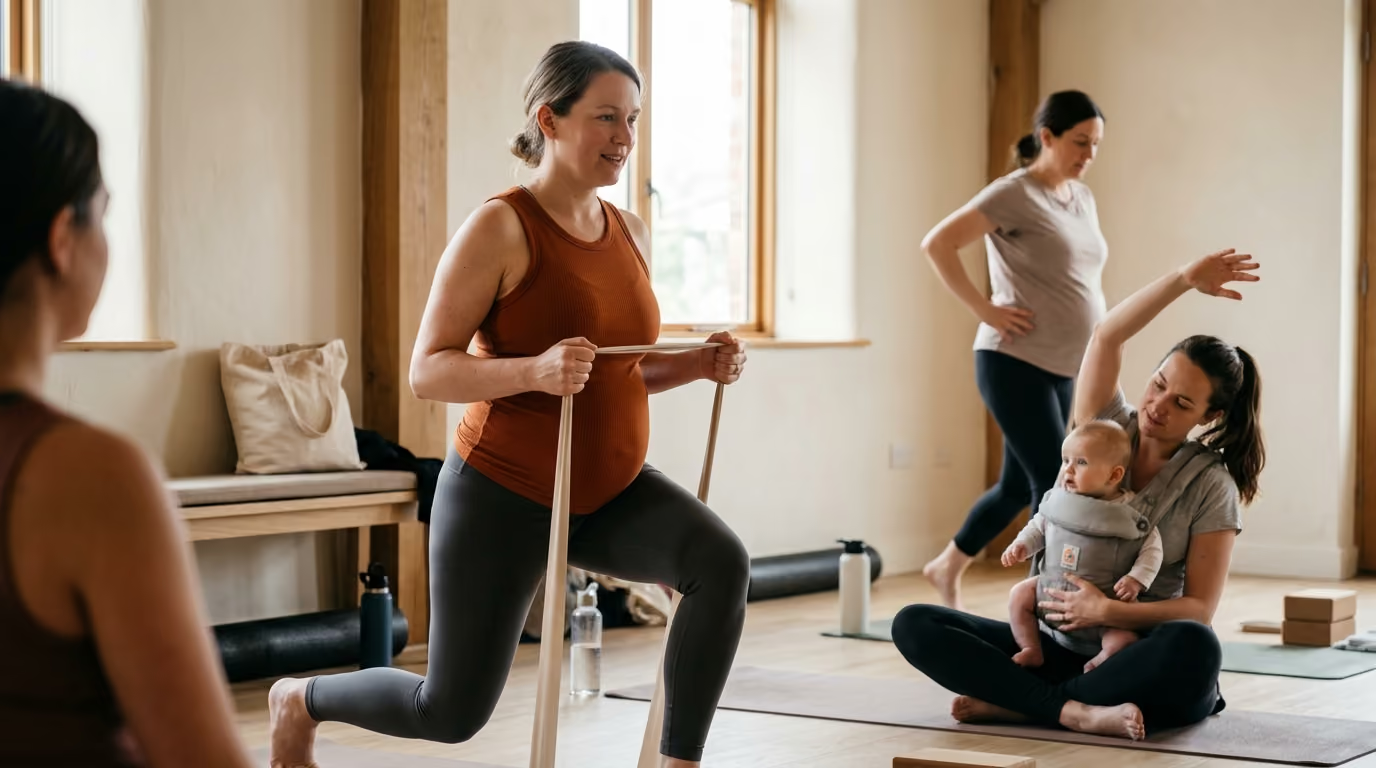
Resistance bands are made of layered latex or synthetic elastic material and generate resistance through mechanical elongation. As the band is pulled, the tension increases along an ascending curve. This means the movement is lightest at the beginning and heaviest at the end of the range of motion.
Bands are the most portable and cost-effective strength tool available. They can be anchored to doors, posts, or under the trainee's feet, allowing for full-body workouts in hotel rooms, parks, or small apartments. Bands can also be looped around barbells or dumbbells to create variable resistance loading, challenging the lifter at their mechanically strongest joint angles.
The primary drawback of elastic resistance is the difficulty of quantifying the exact load. A band labeled medium might provide 15 pounds of tension at slight stretch and 45 pounds at full extension. Bands also provide minimal tension in the starting, lengthened position of many exercises, which is a portion of the range of motion that strongly triggers hypertrophy.
Body-weight training uses the mass of your own body as the resistance against gravity. Fundamental calisthenic movements include push-ups, pull-ups, dips, inverted rows, body-weight squats, lunges, and single-leg variations. Calisthenics requires virtually no equipment and teaches whole-body spatial awareness and relative strength.
Overload in body-weight exercise is achieved through biomechanical manipulation rather than adding external plates. You can alter the difficulty of a movement by changing the angle of your body, shifting from bilateral to unilateral execution, extending the lever arm, or increasing the range of motion. Elevating your feet during a push-up shifts a higher percentage of your body weight onto your upper body, increasing the mechanical demand.
The limitation of body-weight exercise lies in lower-body progression. While the upper body can be overloaded with challenging variations like pull-ups and dips, the legs quickly adapt to standard body-weight squats. Progressing to advanced unilateral movements like pistol squats requires high levels of ankle mobility and balance, which can limit the absolute muscular tension placed on the quadriceps and glutes.
The scientific literature on resistance training modalities has clarified how different tools affect long-term muscular adaptations. For decades, traditional strength culture claimed that free weights were fundamentally superior to machines for building muscle mass. Rigorous systematic reviews and meta-analyses have evaluated this claim.
A comprehensive 2023 systematic review and meta-analysis published in the journal Sports Medicine directly compared muscle hypertrophy between free-weight and machine-based training. The researchers analyzed all available randomized controlled trials and found no statistically significant difference in muscle growth between modalities. The standardized mean difference was -0.055 with a 95 percent confidence interval crossing zero (-0.397 to 0.287), confirming that both modalities stimulate comparable muscle growth when volume and proximity to failure are equated.
A separate systematic review examining strength, power, and hypertrophy outcomes corroborated these findings, reporting an effect estimate for hypertrophy of -0.01 between free weights and machines. A controlled clinical trial investigating previously untrained adult women found that 10 weeks of supervised free-weight versus machine training produced identical increases in muscle cross-sectional area, with between-group differences remaining under 2 percent.
When evaluating maximal strength development, the evidence shows clear task specificity. Strength gains are greatest on the specific movement and testing device used during training. Lifters who train with barbells gain more strength when tested on a barbell one-repetition maximum, with an effect size favoring free weights of 0.655. Lifters who train on machines gain more strength when tested on those machines, showing an effect size of -0.784 favoring machines. When both groups are tested on a neutral testing device, such as an isometric dynamometer, their strength gains are comparable.
The evidence supporting elastic resistance is similarly encouraging. A 2019 meta-analysis published in SAGE Open Medicine evaluated the effects of elastic resistance bands versus conventional resistance training across dozens of trials. The meta-analysis found no significant difference in upper-body strength gains (SMD 0.09, p = 0.52) or lower-body strength gains (SMD -0.11, p = 0.48) between bands and traditional weights. The authors concluded that elastic resistance produces comparable strength adaptations across various populations when programmed with progressive challenge.
Body-weight exercises also stimulate robust adaptations when effort is appropriately matched. In an eight-week comparative study, researchers evaluated the effects of progressive push-up variations against a traditional bench press protocol loaded at 40 percent of one-repetition maximum. Both groups trained to muscular failure and achieved statistically equivalent increases in muscle thickness and strength. This research shows that body-weight exercises can match external loads when the relative muscular challenge is sufficient.
Research evaluating power development shows no inherent superiority for any single modality. A meta-analysis comparing machine and free-weight interventions revealed an effect size of -0.049 for power adaptations, indicating equivalent outcomes. While variable-resistance training with bands can enhance peak contraction velocity, long-term power development is primarily driven by movement intent and high movement speeds rather than the equipment selected.
Surface electromyography (EMG) studies often show higher acute muscle activation in stabilizing muscles during free-weight exercises compared to guided machines. While these measurements confirm higher coordination demands, acute EMG amplitudes do not directly predict long-term hypertrophy. Motor unit recruitment and tension over time within the prime mover determine tissue growth, which explains why machines build comparable muscle mass despite lower stabilizer activation.
The scientific consensus is consistent: your muscles respond to tension, volume, proximity to failure, and progressive overload. The equipment you select is merely the delivery mechanism.
Selecting the right equipment involves matching your primary training goal to the practical advantages of each tool. Rather than limiting yourself to a single modality, an effective program often combines tools to balance fatigue, coordination demands, and joint comfort.
In our experience covering health and exercise science, trainees often encounter dogmatic advice that insists one must choose exclusively between functional free weights or bodybuilding machines. When we examine the clinical data objectively, it becomes clear that combining these tools strategically produces the most sustainable, injury-resilient progress.
When your primary goal is maximal absolute strength in standard competition lifts, free weights must form the foundation of your routine. Strength is a neurological skill that requires regular practice with the exact implements used for testing. Machines and cables can serve as secondary accessory movements to accumulate training volume without overloading your spinal erectors or stabilizing joints.
If your primary objective is regional muscle hypertrophy, machines, cables, and dumbbells provide distinct advantages. They allow you to train muscles close to failure with minimal risk of technical breakdown. You can explore structured exercise selection within our strength, movement, and body composition resources to design balanced hypertrophy splits.
For home training, frequent travel, or low-cost fitness, a combination of resistance bands and progressive calisthenics is highly effective. By manipulating body leverage, pausing at mechanical weak points, and adding bands to body-weight movements, you can create sufficient mechanical tension to build muscle and maintain joint health. For broader strategies on managing long-term physical conditioning, review our guides on sustainable weight management frameworks.
When an exercise in your routine causes joint irritation or is unavailable in your gym, you can substitute it with another modality by matching the fundamental movement pattern.
Step 1: Identify the Primary Movement Pattern. Determine whether the exercise is a horizontal push, horizontal pull, vertical push, vertical pull, knee-dominant squat, or hip-dominant hinge.
Step 2: Match the Plane of Motion and Target Muscle Group. Ensure the alternative exercise trains the same primary movers through a similar joint excursion.
Step 3: Account for Stability Demands. If you are substituting a high-stability barbell exercise with a machine, maintain the same relative effort while taking advantage of the reduced coordination demand to focus on muscular tension.
Step 4: Establish a Clear Overload Metric. Select a measurable progression rule for the new tool, such as increasing repetitions, adding band tension, or increasing the weight pin on the stack.
The following sample routines illustrate how you can program each modality effectively across different contexts.
This program utilizes free weights for fundamental movement skills, machines for stable high-effort volume, and cables for targeted isolation work.
This routine provides a comprehensive strength stimulus using only your body weight and a set of elastic looped resistance bands. You can explore additional conditioning structures in our strength and fitness category.
The belief that free weights build muscle faster than machines remains widespread. Many assume that because barbells require more balance, they naturally stimulate more overall muscle growth. As established by meta-analyses, target muscle hypertrophy is equivalent between machines and free weights when training volume and effort are matched. The additional stabilizer activation seen in free-weight lifts does not translate into greater size gains for the prime movers.
Critics often label machines as non-functional because they constrain movement to a fixed plane. Functionality is entirely dependent on your individual goals. If your goal is to build quadriceps mass while recovering from lower back irritation, a leg press or hack squat is functional because it delivers mechanical tension to the thighs without spinal loading.
Some lifters assume that calisthenics and bands are only suitable for warm-ups or rehabilitation. While adding iron plates to a barbell is the simplest way to track progression, it is not the only way. By manipulating limb leverage, adjusting range of motion, shortening rest intervals, or using thicker bands, you can progressively overload muscles effectively.
A 50-pound dumbbell, a 50-pound machine weight stack, and a band labeled 50 pounds do not impose the same physiological demand. A machine stack often routes through pulleys that halve or double the effective load through mechanical advantage. A band only reaches its rated resistance at maximum elongation. Comparing nominal numbers across different equipment types provides no meaningful insight into actual muscular strain.
While the scientific evidence confirms that all resistance modalities can stimulate adaptation, several practical limitations must be considered. Most published training studies use healthy, untrained young adults over relatively short periods of 8 to 12 weeks. Advanced lifters may encounter equipment-specific ceilings that do not appear in short-term studies.
Body-weight exercises eventually hit a progression ceiling for lower-body strength. While an untrained person can build substantial leg muscle with lunges and split squats, a well-trained individual will eventually require external loading that exceeds what calisthenics can easily provide. Attempting complex balance feats like single-leg pistol squats may fail due to balance limitations rather than muscular fatigue of the quadriceps.
Equipment design introduces another practical limitation. Fixed-path machines manufactured for average body proportions can cause joint strain for individuals who are unusually tall, short, or have unique limb-to-torso ratios. In these cases, dumbbells, cables, or bands are more suitable because they allow the joints to follow an unconstrained path.
Safety and setup logistics also vary by modality. Training to complete muscular failure on a barbell bench press or back squat carries significant risk without safety pins or spotters. Machines and cables allow for high-effort training without the danger of being trapped beneath a load. For deeper perspectives on metabolic adaptations and muscular recovery, visit our section on weight science research.
The physical pulling force developed within active muscle fibers when they contract against an opposing resistance. Mechanical tension is the primary stimulus for muscular hypertrophy and triggers biochemical pathways that promote protein synthesis.
The perpendicular distance from the line of an applied force to the axis of rotation of a joint. The length of the moment arm determines how much rotational torque a given weight places on the muscles crossing that joint.
The amount of active muscular control and neural coordination required to stabilize the body, joints, and external implement during an exercise. Free weights have high stability demands, while selectorized machines have low stability demands.
The dynamic profile of force required to move a load throughout the range of motion of an exercise. The resistance curve can be constant, ascending, descending, or bell-shaped depending on gravity, leverage, cams, and elastic properties.
Building an effective strength training routine does not require choosing one tool over another. You can apply the underlying principles of resistance training using whatever equipment you currently have available.
Use this checklist to refine your training plan this week:
WeightRestart shares research-led guidance on weight loss, metabolism, nutrition, strength, appetite, sleep and recovery. Our goal is to make complex health information clear, practical and useful for people building progress they can maintain.



Learn how to build a weight-management approach around better information, realistic expectations and habits you can keep using.
read the blog