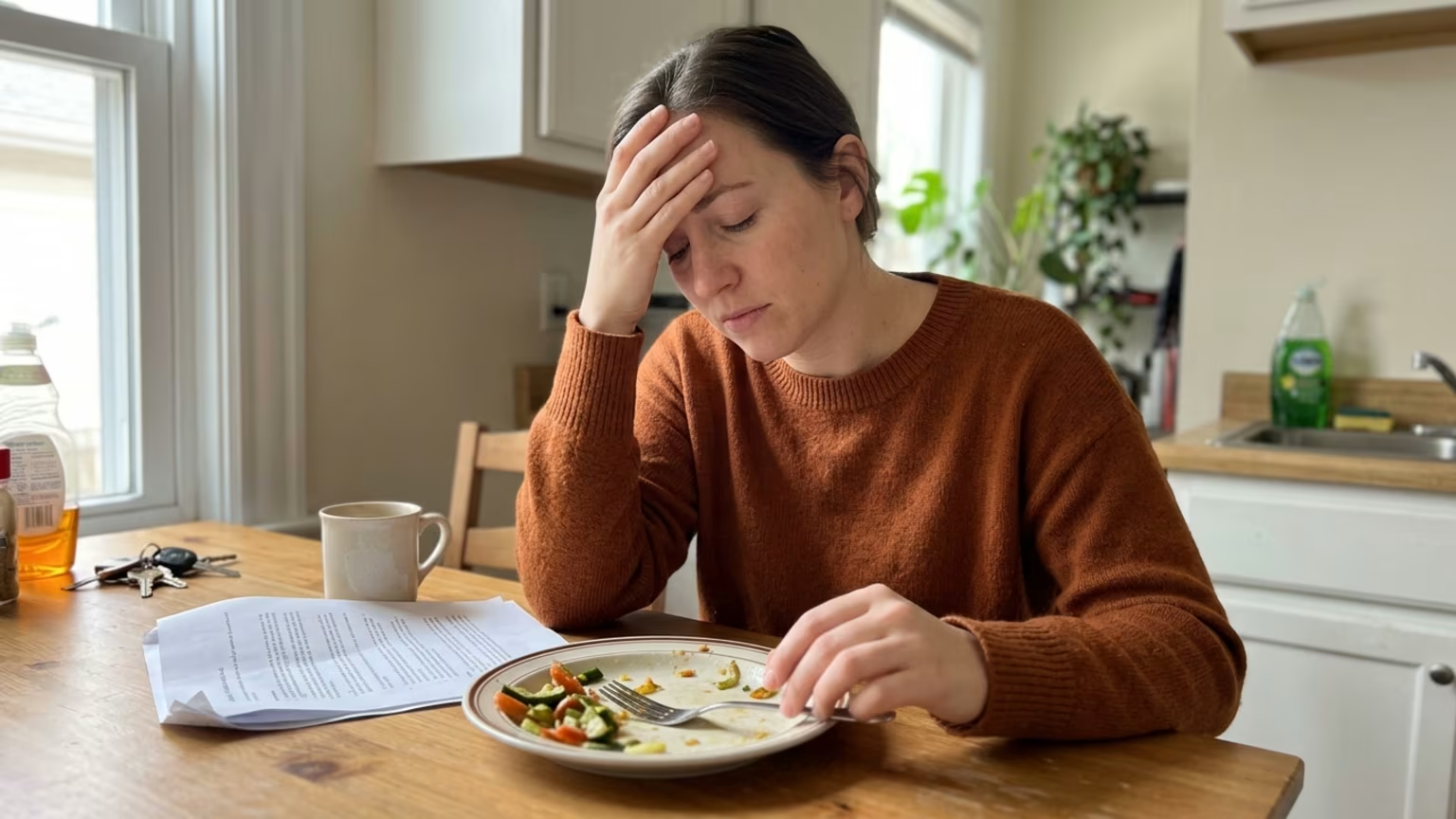

A 2026 analysis examines how online nutrition communities turn diets into rigid belief systems. Learn how to spot dogmatic rules and build flexible habits.





On September 10, 2026, the American Council on Science and Health published a new commentary examining how online nutrition communities can shift into rigid belief systems. This publication highlights a growing trend where food choices become deeply fused with personal identity. According to the commentary, this shift often displaces context-dependent reasoning with strict rules and hostility toward outsiders. The central warning is that when questioning a diet feels like questioning your identity, a supportive community has crossed into dogmatism.
The commentary analyzed theoretical models of how digital platforms like Reddit, Facebook, and YouTube facilitate these group dynamics. It focused on the subtle transition from shared dietary interests to inflexible, authority-dependent cultures. Researchers warned that dietary practices can easily fuse with a person's sense of self. When this fusion happens, updating beliefs based on new evidence becomes psychologically painful.
The psychological shift from a simple food preference to a rigid belief system relies on a phenomenon known as cognitive closure. Cognitive closure is the deep human desire for a definitive answer that ends uncertainty. In a confusing landscape of conflicting research, strict dietary rules provide a comforting sense of order. When an eating pattern promises absolute certainty, it stops being just a menu and becomes a worldview.
This transformation is heavily reinforced by charismatic authority figures who use personal transformation stories to establish deep trust. These leaders often employ scientific terminology and biochemical explanations to build credibility with their audiences. Once authority is established, the group begins to define itself by rigid insider boundaries and shared terminology. The commentary notes that this environment quickly creates a dynamic where questioning the leader feels like betraying the entire community.
For years, I watched smart, capable people blame themselves when standard diet advice failed them. They would cut calories drastically, run themselves into the ground, and inevitably regain the weight. It was heartbreaking to see. I realized we were treating a complex biological and psychological system like a simple math problem.
That was the turning point when I knew we had to focus on metabolic health and habits rather than just restriction. In rigid online communities, complex metabolic functions are frequently reduced to simplistic moral classifications of good versus bad foods. This moralization makes deviation from the diet feel like a moral failure rather than a normal choice. Instead of learning to navigate real life, followers become trapped in an ideological echo chamber.
The commentary draws a fascinating parallel to the 1954 Seekers case, a historical example of cognitive dissonance. In that famous psychological study, a group's failed prediction was stubbornly reinterpreted as evidence that their faith had actually saved the world. This same mechanism operates in online diet communities when physiological warning signs are ignored. Rather than abandoning a deeply invested worldview, followers reinterpret negative symptoms as proof that the diet is working.
The mainstream media often labels extreme dietary groups as food cults. The reality is much more nuanced because there is no established clinical definition of a food cult. A radical diet and an enthusiastic influencer do not automatically prove that a group is coercive. A study of 31 former cult members noted in the commentary found that more than 80 percent left voluntarily.
This suggests that participants maintain agency and often join these groups seeking belonging rather than extreme dogmas. Strong commitment and enthusiasm for a specific eating pattern do not inherently equal irrationality. It is vital to distinguish between a supportive environment and a coercive one. The existence of identity and community can offer incredibly positive functions like belonging, motivation, and structure.
A shared focus on nutrition and eating strategies can help people stay consistent on difficult days. The problem only arises when that belonging depends on absolute obedience, hostility toward outsiders, or the total rejection of contrary scientific evidence. Furthermore, digital tools and online communities are not always harmful to our health goals. A 2026 review of digital nutrition interventions found that online programs can effectively support dietary adherence.
Positive nutrition behaviors actually increase when these digital tools are combined with professional support. The true difference lies in whether the community encourages flexible behavior change or enforces rigid compliance. However, the sheer scale of inaccurate information remains a massive hurdle for adults seeking sustainable health. Recent reporting on a 2026 study of 300 TikTok and Instagram videos found that at least 68 percent of the sampled content contained misleading information.
In that exact sample, content from credentialed creators was accurate 45.5 percent of the time. Meanwhile, unqualified influencers in the same study had a factual accuracy rate of just 4.7 percent. Additionally, a 2026 Harvard Kennedy School Misinformation Review article reported that pseudoscientific content increases the perceived credibility of health misinformation. This environment rewards extreme claims over careful, evidence-based nutrition.
The commentary highlights extreme carnivore and vegan communities to illustrate how nutritional evidence is selectively interpreted. In dogmatic circles, contradictory clinical data is frequently dismissed or reinterpreted to protect the group's worldview. For instance, the commentary cites Cochrane evidence showing that replacing saturated fat with polyunsaturated fat consistently reduces cardiovascular events. In rigid online communities, such established data is often ignored or reframed as irrelevant.
The article points out how carnivore groups portray plants as universally harmful due to compounds like lectins. Meanwhile, physiological symptoms like diarrhea or severe malaise are reportedly reframed by influencers as natural oxalate dumping. This reinterpretation mirrors cognitive dissonance, where conflicting evidence is warped to fit a deeply invested worldview. By rejecting objective clinical markers, followers expose themselves to unnecessary metabolic risks.
On the other end of the spectrum, some groups enforce a purely plant-based approach without addressing physiological reality. The Academy of Nutrition and Dietetics states that a well-planned vegan diet is nutritionally adequate. However, this adequacy requires careful attention to specific nutrients like vitamin B12. When ideological purity overrides scientific evidence, followers risk ignoring critical nutritional gaps in their daily meals.
Professional credentials do not automatically make every online claim correct. Conversely, a lack of formal credentials does not prove that every statement is entirely false. The strongest test of reliability is whether dietary claims are proportionate to the clinical evidence. Followers must verify if an influencer is open to scientific scrutiny or if they treat disagreement as personal betrayal. A diet should serve your physiological needs rather than demanding blind loyalty.
Sustainable weight management depends on addressing these health realities objectively and learning how to read nutrition labels properly. It is critical to remember that weight change is never simply a matter of willpower. True metabolic health relies on a supportive environment, sustainable habits, adequate sleep, and proper nourishment. Flexible approaches will always outperform unyielding restriction over the long term.
As social platforms continue to shape our dietary habits, future research must examine how algorithms and user agency mutually influence eating behaviors. We need robust, long-term studies to understand how identity fusion affects a person's ability to transition to more adaptable eating patterns. Researchers should also investigate the specific psychological barriers that prevent adults from leaving ineffective diet communities. These insights will help practitioners design better interventions for those struggling with extreme food rules.
Observing how credentialed professionals can better communicate nuance in a digital space that rewards certainty will be crucial. We must learn how to promote healthy convenience foods without moralizing every single ingredient. Until the digital landscape evolves, we must ensure our eating patterns remain flexible to new evidence. The healthiest approach is to maintain a supportive community while keeping our identities completely separate from our dinner plates.
WeightRestart shares research-led guidance on weight loss, metabolism, nutrition, strength, appetite, sleep and recovery. Our goal is to make complex health information clear, practical and useful for people building progress they can maintain.






Learn how to build a weight-management approach around better information, realistic expectations and habits you can keep using.
read the blog