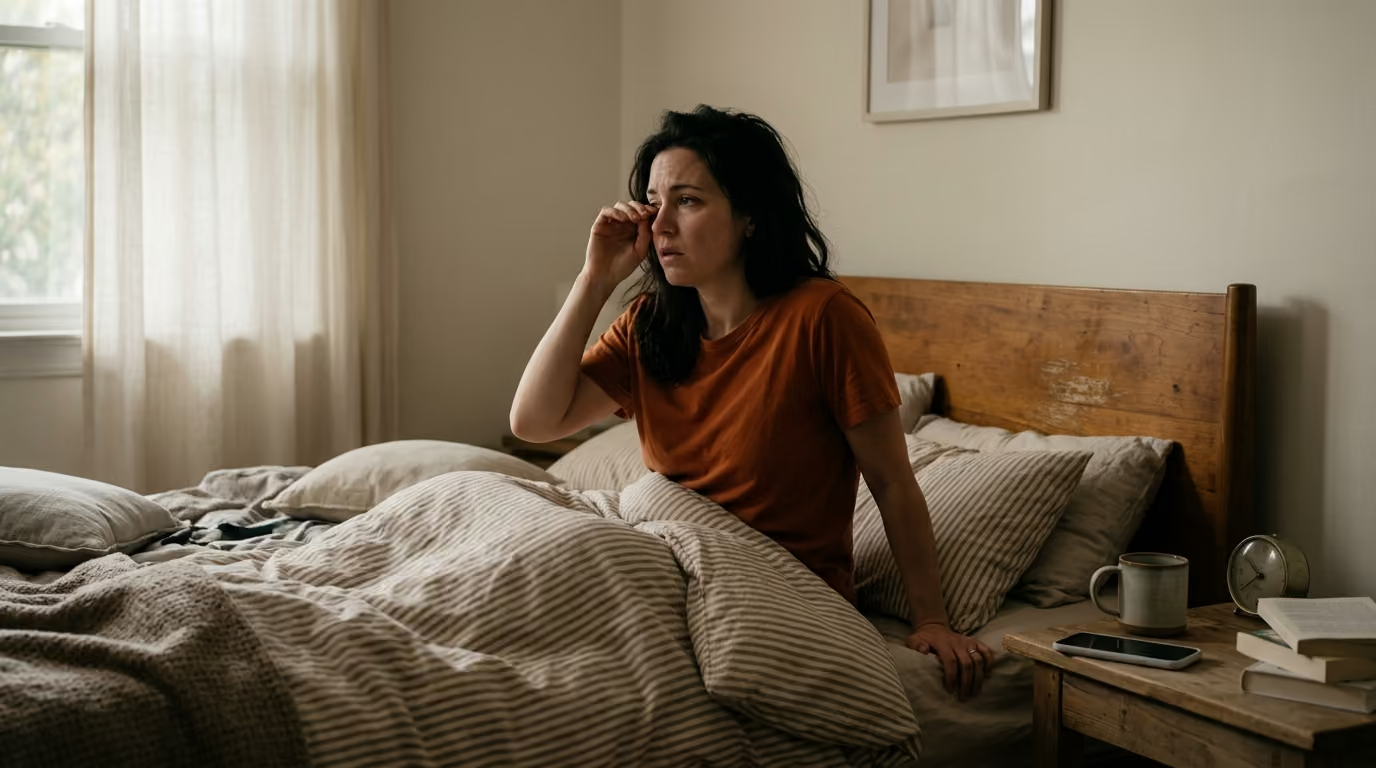

Sleep perfectionism and excessive tracker preoccupation often fuel presleep arousal, but evidence-based behavioral strategies can help rebuild natural sleep.





Many people wake up feeling exhausted, reach for their phone, and search: "Why do I feel tired when my sleep score was 85?" Others search for why their wearable tracker shows almost no deep sleep despite resting in bed for eight hours. When you seek advice on improving your recovery, the common recommendation is to track every metric and optimize every variable. Yet for millions of adults, this intense focus creates a frustrating paradox. The harder they try to force an ideal night of rest, the worse their sleep becomes.
This guide provides a definitive answer to that paradox. Perfectionistic sleep monitoring, excessive effort to fall asleep, and rigid expectations can turn bedtime into a performance test. When you treat sleep as an exam you must pass, your autonomic nervous system responds with alertness rather than relaxation. By understanding the science behind sleep trackers, recognizing the psychological drivers of orthosomnia, and adopting flexible behavioral strategies, you can rebuild trust in your body's natural sleep systems.
In 2017, researchers at Rush University Medical Center and Northwestern University identified a growing clinical phenomenon. Patients were arriving at sleep clinics distressed by the data displayed on their wearable devices. Even when laboratory assessments showed normal sleep, these individuals remained convinced that their rest was broken. The researchers coined the term orthosomnia, combining "ortho," meaning correct or proper, with "somnia," meaning sleep.
Orthosomnia describes an unhealthy preoccupation with achieving perfect sleep data. The condition differs from traditional primary insomnia because the primary source of anxiety is often the tracker itself. People with orthosomnia do not just worry about feeling tired during the day. They worry about the algorithm's judgment of their sleep stages, recovery scores, and resting heart rate.
Published prevalence estimates for this pattern vary widely because researchers are still working toward a standardized clinical definition. A 2024 general population study found that 35.8% of participants regularly used digital sleep-tracking devices. Depending on the diagnostic threshold used, algorithm-identified orthosomnia appeared in 3.0%, 8.6%, or 14.0% of the sample. These variations reflect conservative, moderate, and lenient scoring criteria applied by researchers.
A 2026 national survey abstract similarly reported that roughly one in three adults in the United States used a digital tool to monitor rest. Among those who tracked their sleep, 30.9% screened positive for orthosomnia risk based on an adapted screening metric. Because this finding came from a conference abstract, clinicians treat it as an emerging indicator rather than a settled statistic. Nevertheless, it demonstrates that sleep data anxiety is a widespread consequence of the wearable device era.
Early in our research, we reviewed a study showing how just a few nights of poor sleep could significantly alter appetite hormones. It was a clear revelation. So many people were meticulously tracking their food but completely ignoring their sleep and stress levels. We immediately shifted our editorial focus to include recovery as a fundamental pillar alongside appetite regulation and daily habits. However, as tracking technology expanded, we also noticed a secondary problem emerge: people were turning recovery into another stressful chore.
Tracking devices are not inherently destructive. They offer helpful information about broad lifestyle patterns when interpreted with emotional detachment. The problem arises when an individual treats an imperfect estimate as an absolute truth. When a low score dictates your mood, productivity, and schedule for the day, the tracker has shifted from a passive observer to an active disruptor of your health.
Sleep is fundamentally an involuntary biological process governed by two distinct systems. The first is the homeostatic sleep drive, which accumulates adenosine in the brain the longer you remain awake. The second is the circadian timing system, which regulates the release of melatonin and cortisol in response to environmental light cues. Neither of these biological drivers responds positively to conscious willpower or active effort.
When you try hard to fall asleep, you introduce conscious evaluation to an automatic process. Deliberate effort requires cognitive monitoring, which activates the prefrontal cortex and the sympathetic branch of the autonomic nervous system. This activation increases heart rate, core body temperature, and plasma cortisol levels. These physiological changes directly oppose the natural cooling and cardiovascular slowing required for sleep onset.
Researchers measure this struggle using specialized tools such as the Glasgow Sleep Effort Scale. This clinical instrument assesses the degree of conscious striving a person uses to initiate or maintain rest. People who score high on this scale often describe lying in bed actively checking for signs of drowsiness. They evaluate whether their thoughts are slowing down or monitor their breathing patterns. This self-surveillance acts as a cognitive task, sustaining daytime alertness instead of allowing natural sedation.
Excessive monitoring triggers a rapid feedback loop that reinforces sleep disturbance:
Breaking this cycle requires recognizing that sleep cannot be forced through discipline. Effort works well for strength training, career projects, and nutritional planning. Sleep, however, requires the systematic withdrawal of effort. When you surrender the demand to control the exact minute you lose consciousness, the autonomic nervous system naturally settles into the parasympathetic state needed for recovery.
Perfectionism is a multidimensional personality trait that influences how people approach health goals, work, and personal standards. Psychologists divide perfectionism into two main categories: perfectionistic strivings and perfectionistic concerns. Perfectionistic strivings involve setting ambitious standards and aiming for excellence. Perfectionistic concerns involve harsh self-criticism, constant fear of failure, chronic doubt about one's actions, and intense worry about negative evaluation.
A comprehensive meta-analysis on multidimensional perfectionism demonstrated that perfectionistic concerns are consistently tied to poor rest. The pooled association with insomnia severity was moderate and positive, showing that self-critical worry worsens sleep disturbance. Similarly, perfectionistic concerns showed a reliable link to worse scores on the Pittsburgh Sleep Quality Index.
By contrast, perfectionistic strivings showed a much smaller link to insomnia severity and no significant relationship with general sleep quality. This distinction is critical for anyone pursuing evidence-based wellness. Having high standards for your recovery is not inherently dangerous. The hazard lies in the punitive self-judgment that arises when your biology does not meet those theoretical standards.
Bedtime counterfactual processing serves as a major psychological pathway linking perfectionism to insomnia. Counterfactual thinking involves mentally reviewing past events while focusing on what you should have done differently. A study evaluating this mechanism found that concern over mistakes and doubts about actions correlated with insomnia severity. The frequency of bedtime feelings such as regret, shame, and frustration largely explained why perfectionistic individuals struggled to rest.
Instead of allowing the brain to power down, the perfectionistic sleeper treats the bedroom as an evaluation room. They review their daily diet, their step count, their evening screen time, and their adherence to strict routines. If any variable was imperfect, they anticipate a poor night of rest, triggering presleep cognitive arousal.
Research also indicates that perfectionism does not operate in isolation. Studies show that daily stress, coping mechanisms, and emotional regulation account for more variance in sleep disruption than static personality traits alone. Perfectionism increases your vulnerability to sleep problems primarily by amplifying your emotional reaction to normal, everyday variations in rest.
Not every study shows a direct relationship between perfectionism and objective sleep metrics. A 2024 daily-life investigation of individuals with insomnia found that higher perfectionism did not reliably predict worse objective sleep measured prospectively. Another study utilizing wrist actigraphy showed that while perfectionism correlated with subjective sleep complaints, the associations differed significantly when looking at objective motion data.
These mixed findings provide a reassuring truth: perfectionism does not permanently damage your sleep architecture. It primarily alters your perception of sleep and elevates nighttime anxiety. When you address the emotional pressure surrounding sleep, the physical body usually recovers its natural rhythm without requiring aggressive interventions.
Consumer sleep trackers have revolutionized how we look at personal health, but their technological limitations are substantial. These devices rely on surrogate markers like wrist movement, optical photoplethysmography for heart rate variability, and skin temperature. They do not measure brain waves, eye movements, or chin muscle activity, which are the clinical gold standards used in laboratory polysomnography.
A 2025 systematic review and meta-analysis evaluated wearable device performance against polysomnography across dozens of trials. The researchers found that consumer wearables consistently overestimated total sleep time and sleep efficiency. At the same time, the devices systematically underestimated wake after sleep onset. There was also extreme performance variability across different brands, device generations, and patient populations.
The meta-analysis concluded that while wearables offer acceptable estimates for general sleep duration over multi-week periods, they cannot serve as stand-alone diagnostic instruments. Their stage-tracking algorithms perform poorly when tasked with distinguishing light sleep from deep sleep or rapid eye movement (REM) sleep.
A clinical comparison of three major commercial wearables found that the sensitivity for correctly distinguishing specific sleep stages ranged from 50% to 86%. In practical terms, this means that an algorithm classifying a block of time as light sleep instead of deep sleep can be wrong up to half the time. Another clinical trial showed that a popular consumer ring significantly underestimated deep sleep and wakefulness while overestimating total sleep duration. The investigators concluded that the device was unsuitable for guiding clinical sleep interventions.
When users do not understand these technical boundaries, they place absolute faith in arbitrary numbers. A user might wake up feeling clear-headed, energetic, and rested. However, after checking their phone and seeing a "sleep score" of 62 with "low deep sleep," their perception shifts entirely. They begin to experience subjective fatigue, brain fog, and irritability, a phenomenon known as negative sleep state misperception.
To use technology responsibly, you must view your wearable as a rough weather vane rather than a precision scale. It can display general trends across several months, such as whether a new schedule allows more time in bed. It cannot, however, provide an accurate medical verdict on the cellular or neurological restoration that took place inside your brain last night.
Misinformation regarding sleep stages fuels much of the anxiety seen in orthosomnia. Commercial apps often display gamified interfaces with bright color-coded targets for deep sleep, REM sleep, and sleep efficiency. These designs encourage users to believe that human sleep should remain identical and optimized every night. Examining the real science behind these metrics dispels that harmful belief.
Many individuals believe that failing to achieve two hours of deep sleep every night means their muscles and brain cannot recover. In clinical physiology, slow-wave sleep is heavily homeostatic. The body prioritizes deep sleep early in the night based on prior wakefulness and energy expenditure.
Deep sleep naturally decreases with age, and its duration varies based on training volume, stress, and baseline health. A lower deep sleep reading on a wearable is far more likely to reflect algorithmic error than actual physical degeneration.
Sleep applications often penalize users heavily for brief awakenings, displaying fragmented graphs that cause panic. In reality, brief awakenings are an entirely normal component of human sleep architecture.
Healthy adults experience multiple micro-arousals at the end of each ninety-minute sleep cycle as they shift between stages. Most people do not remember these awakenings unless they stay awake for several minutes. Viewing these natural transitions as defects creates unnecessary dread about normal physiology.
Public health messaging frequently emphasizes the dangers of chronic sleep deprivation on insulin sensitivity, appetite regulation, and cardiovascular health. While chronic short sleep does influence metabolism, perfectionists often misinterpret this research. They believe that a single night of five or six hours of sleep will instantly ruin their health or derail their body composition goals.
Human physiology is resilient and adapted to handle periodic disruptions in rest. The body compensates for an occasional short night by increasing sleep pressure, which deepens slow-wave sleep the following night. Believing that one difficult night causes permanent harm generates the exact panic that prevents sleep from returning naturally.
Escaping the trap of sleep perfectionism requires transitioning from rigid control to evidence-based behavioral flexibility. Clinical medicine approaches persistent sleep disruption through Cognitive Behavioral Therapy for Insomnia (CBT-I). Rather than demanding immediate sleep optimization, this methodology modifies the underlying beliefs and conditioned responses that keep the brain awake.
The American Academy of Sleep Medicine (AASM) recommends behavioral and psychological interventions as the primary treatment for chronic sleep disruption. These treatments do not rely on tracking apps or endless supplement stacks. Instead, they focus on two highly validated tools: stimulus control and paradoxical intention.
Stimulus control was designed to break the conditioned association between the bed and mental frustration. When an individual spends hours tossing, turning, and analyzing their tracker data, the bedroom becomes a trigger for alertness. Stimulus control restores the bed as a clean physiological cue for sleep.
The guidelines for implementing stimulus control are straightforward:
Stimulus control removes the pressure to perform. Getting out of bed is not an admission of defeat; it is an intentional strategy to prevent your brain from linking the mattress with anxiety.
Paradoxical intention is a behavioral technique that directly attacks performance anxiety. First identified in clinical psychology and supported by systematic reviews, this approach instructs the patient to abandon all effort to fall asleep. Instead, the individual is guided to remain comfortably and passively awake in a dark, quiet room.
When a person tries to stay awake without agitation, they remove the fear of insomnia. Performance anxiety vanishes because falling asleep is no longer the metric of success. Meta-analyses demonstrate that paradoxical intention significantly reduces sleep effort and presleep worry.
The technique must be applied without hidden motives. If you think, "I will pretend to stay awake so that I fall asleep faster," you are still running a performance program. The goal is genuine acceptance of quiet wakefulness. Rest in bed and appreciate the physical comfort of lying still, knowing that resting quietly still provides restorative value to your muscles and nervous system.
For readers seeking structured guidance on nervous system balance and recovery routines, our collection of evidence-based sleep and recovery strategies offers practical, non-dogmatic resources.
You do not necessarily have to throw away your fitness tracker to recover from sleep perfectionism. However, you must change your relationship with the numbers. If checking your daily recovery score creates dread, frustration, or behavioral paralysis, your tracking habits require clear boundaries.
A healthy tracking routine treats data as secondary to your subjective experience. If you wake up feeling energized, that internal state is your reality, regardless of what an algorithm calculates. If you wake up feeling groggy, you can acknowledge it with curiosity, drink some water, seek morning sunlight, and move on with your day without catastrophizing.
To establish a healthier framework with your devices, implement these behavioral rules:
These boundaries help you transition from being a passive subject judged by an algorithm to an active participant in your recovery.
While addressing perfectionism resolves many sleep issues, it is essential to distinguish psychological sleep anxiety from underlying medical conditions. De-emphasizing sleep effort should never be used as an excuse to ignore genuine physiological pathology.
Consumer wearables cannot diagnose medical conditions, but persistent symptoms warrant formal evaluation by a qualified medical professional. You should consult a board-certified sleep specialist or primary care physician if you experience any of the following clinical signs:
When genuine medical disorders like obstructive sleep apnea or restless legs syndrome are present, relaxation techniques and boundary-setting around wearables are insufficient. These conditions require formal diagnostic testing, such as in-lab polysomnography, and medical therapies like continuous positive airway pressure (CPAP) or targeted medical management.
Additionally, standard behavioral strategies like stimulus control and sleep restriction must be tailored carefully for specific populations. Individuals with bipolar disorder, active seizure disorders, or occupations requiring absolute vigilance should only undertake significant behavioral sleep adjustments under direct medical supervision.
Our broader library of weight management resources emphasizes that true health stems from understanding clinical boundaries. For more information about our editorial standards and review processes, you can review our evidence-led approach.
Understanding the precise vocabulary used in sleep research helps demystify clinical studies and prevents the misinterpretation of everyday sleep issues.
Recovering from sleep perfectionism is not about giving up on good health. It is about removing the emotional urgency and performance pressure that prevent your natural biology from functioning. Use this implementation checklist to restore a calm, confident relationship with your sleep this week.
By systematically stripping away the rules, measurements, and self-judgment surrounding bedtime, you allow your autonomic nervous system to downshift naturally. Sleep was never an exam designed for you to pass. It is an innate biological process that returns when you give up the struggle to control it.
WeightRestart shares research-led guidance on weight loss, metabolism, nutrition, strength, appetite, sleep and recovery. Our goal is to make complex health information clear, practical and useful for people building progress they can maintain.



Learn how to build a weight-management approach around better information, realistic expectations and habits you can keep using.
read the blog