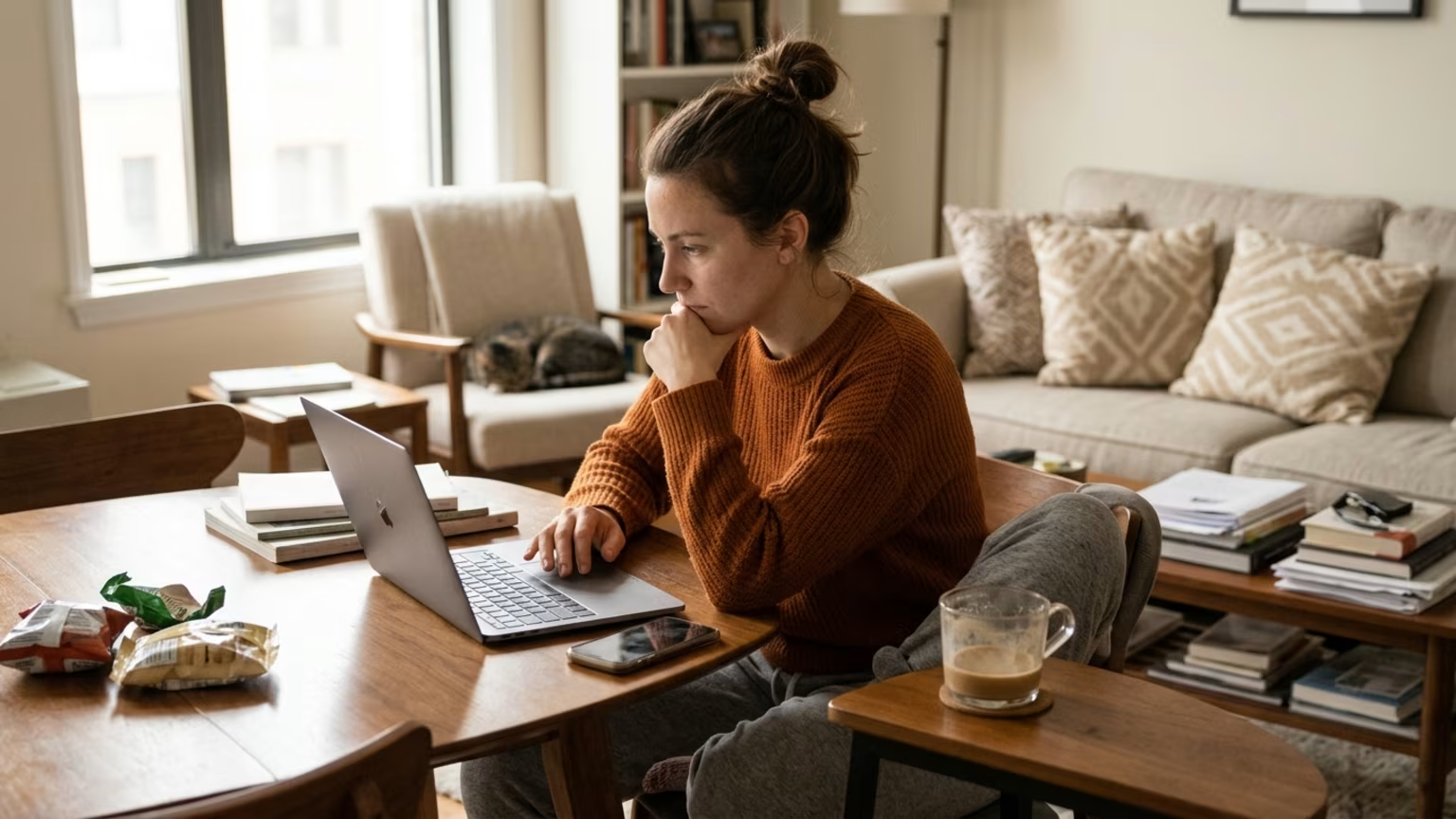

A 2026 study reveals remote work increases time in bed but significantly raises sedentary behavior. Learn how to balance sleep recovery with daily movement.





In 2026, the International Journal of Behavioral Nutrition and Physical Activity published new findings regarding how 24-hour movement patterns differ between remote and office workdays. A Finnish WORKDAY study examined these shifts among hybrid workers using thigh-worn accelerometers. The study is part of the University of Turku's broader WORKDAY research program. This initiative examines how the increase in remote work after the COVID-19 pandemic has affected physical activity and sedentary behavior during workdays.
The research utilized a thigh-worn accelerometer to measure sleep and sedentary behavior. The device also recorded standing, light physical activity, and moderate-to-vigorous physical activity across both office and remote workdays. Participants wore the sensor for seven consecutive days to provide a detailed view of their habits. The results highlighted a distinct tradeoff where remote workdays were associated with slightly more sleep but substantially more sedentary time.
The study materials describe a sample of roughly 100 hybrid workers. The journal article reports 97 participants, and the University of Turku release reports 99 participants. The researchers used within-person comparisons and adjusted the data for sex, age, and body mass index. This approach allowed the team to observe how the exact same individuals behaved differently depending on their work location.
The core mechanism driving these changes relates to how daily time is redistributed when commuting disappears. When employees work from home, they often skip the incidental movement required to travel to an office. The study's time-redistribution analysis indicated that standing and cycling were mainly replaced by sedentary behavior and time in bed. Walking and cycling associated with office days were at least partly replaced by sitting or lying down on remote days.
This shift alters the fundamental balance of daily energy expenditure. The researchers reported that the ratio of active behaviors to passive behaviors was significantly lower on remote workdays. The reported significance level for this shift was p<.0001. A lower active-to-passive ratio means the body spends far more consecutive hours without the muscular contractions that support healthy metabolic function.
Kristin Suorsa of the University of Turku provided insight into these specific shifts. She said the increase in sitting or lying down was mostly explained by less standing. Suorsa suggested that home work environments do not always offer standing workstations. Without a dedicated standing desk or a reason to walk to a meeting room, workers simply remain seated for longer uninterrupted blocks.
The detailed study comparison provides clear metrics on how behavior changed. On office workdays, participants spent approximately 7.6 hours in bed and 10.6 hours in sedentary states. They also recorded 5.0 hours in light physical activity and 49 minutes in moderate-to-vigorous physical activity. These office-day baselines show a substantial amount of daily movement.
When switching to remote work, participants spent approximately 14 extra minutes in bed and 44 extra sedentary minutes. They also recorded 37 fewer minutes of light physical activity and 21 fewer minutes of moderate-to-vigorous physical activity. The public news release summarizes these findings as roughly 15 additional minutes of sleep and 45 additional minutes of sitting or lying down. The researchers also reported a significantly higher ratio of light physical activity to moderate-to-vigorous physical activity on remote workdays.
This shift in activity intensity is highly relevant for long-term health. A higher ratio of light physical activity to moderate-to-vigorous physical activity on remote workdays was observed. The researchers reported the significance level for this specific shift at p<.0001. When employees work from home, they not only move less overall but also engage in less vigorous movement.
These observations fit into broader conversations about public health and daily movement. World Health Organization guidance generally recommends 150 to 300 minutes of moderate-intensity aerobic activity for adults. They alternatively recommend 75 to 150 minutes of vigorous-intensity activity or an equivalent combination. The guidelines suggest that adults should reduce overall sedentary behavior and accumulate regular physical activity.
However, the World Health Organization guidance does not establish one universal safe maximum number of sitting hours for all adults. The lack of a universal maximum means individuals must assess their own baseline activity levels. Losing 21 minutes of moderate-to-vigorous activity per remote workday can quickly impact a person's ability to meet weekly targets. This deficit requires deliberate planning to overcome.
Mainstream summaries might suggest that working from home ruins metabolic health, but the actual data requires a calmer interpretation. The study measured behavior rather than body weight, fat mass, waist circumference, or glucose. It cannot establish that remote work caused weight gain or a specific change in energy balance. The findings simply highlight a movement deficit that occurs naturally when incidental office activity disappears.
It is also important to view the sleep data critically. The detailed article page reports that participants self-reported their time in bed while the sensor identified postures and activity types. The extra 14 or 15 minutes in bed should not automatically be described as high-quality sleep. Time in bed is not identical to objectively confirmed sleep efficiency.
Recent clinical literature continues to distinguish sleep duration from overall sleep quality. A 2026 review involving 18 studies and 7,715 participants investigated these variables closely. The researchers reported associations between very short sleep and sleep of at least nine hours and adverse glucose metabolism. These associations were specifically noted among people with overweight or obesity, though researchers also noted heterogeneity in the findings.
Our team at WeightRestart values sleep highly, but we also recognize the need for balance. Early in our research, we reviewed a study showing how just a few nights of poor sleep could significantly alter appetite hormones. It was a clear revelation for us. So many people were meticulously tracking their food but completely ignoring their sleep and stress levels.
We immediately shifted our editorial focus to include recovery as a fundamental pillar of weight management alongside nutrition and movement. Understanding appetite signals requires a comprehensive view of daily habits. Preserving the extra recovery time from remote work is extremely valuable for metabolic function. However, additional time in bed does not automatically offset a large reduction in daily movement or guarantee improved metabolic health.
The study population provides essential context for interpreting these behavioral shifts. The journal article reports a mean age of 42 years with a standard deviation of 10 years. Furthermore, 84 percent of the participants were women, and they were all university employees in Finland. The results may not generalize perfectly to all occupations, ages, or home-working arrangements.
The extra sedentary time observed was not necessarily all work-related sitting. The study's sedentary category included sitting or lying down, and the ratio of sedentary behavior to time in bed did not differ significantly between the two workday types. The reported significance level for this specific ratio comparison was p=.15. An individual who replaces a long commute with a planned morning walk may not experience the same movement loss as someone who remains seated all day.
The tradeoff observed in this Finnish WORKDAY study is an average group difference rather than an absolute rule. Individual responses can vary substantially based on personal habits and specific home environments. Readers should avoid using the 45-minute sedentary increase as a personal diagnosis. Instead, reframing physical activity around individual needs offers a more productive path forward.
The researchers concluded that practical ways to compensate for these behavioral differences may be warranted. The University of Turku research team recommended varying working positions and interrupting sitting with meaningful activities. They also suggested taking longer active breaks on remote days and discussing break practices with the work community. Adding leisure-time physical activity to remote workdays was another primary recommendation from the research team.
These are practical behavior-change suggestions from the researchers rather than absolute directives. They do not serve as evidence that a single strategy produces a particular amount of weight loss or changes body composition by a predictable percentage. For adults already struggling with fatigue, the priority need not be extreme exercise. Modest and repeatable interruptions to sitting may be more realistic than adding a punishing workout after a sedentary workday.
Implementing sustainable recovery strategies for busy adults can help maintain energy without adding undue physical stress. A practical routine could include standing for parts of meetings, walking during selected calls, or taking a short movement break between work blocks. Scheduling a walk at the time a commute would normally occur is another direct application of the study team's advice. These realistic steps help bridge the gap left by missing office commutes.
For sustainable weight management, daily movement planning should be paired with attention to food intake and sleep quality. The Finnish study measured movement and time in bed rather than dietary intake or long-term body composition changes. Readers should not assume that one healthy behavior compensates perfectly for the absence of another. Preserving the recovery benefit of a remote schedule while deliberately replacing lost incidental movement remains a highly effective goal.
Future research will likely investigate long-term metabolic outcomes for hybrid workers to see how these behavioral shifts affect actual body composition over time. Scientists also need to evaluate whether specific workplace interventions can successfully restore the active-to-passive behavior ratio in home environments. Until more clinical data emerges, adults should focus on finding realistic ways to integrate small movement breaks into their remote schedules.
WeightRestart shares research-led guidance on weight loss, metabolism, nutrition, strength, appetite, sleep and recovery. Our goal is to make complex health information clear, practical and useful for people building progress they can maintain.





Learn how to build a weight-management approach around better information, realistic expectations and habits you can keep using.
read the blog