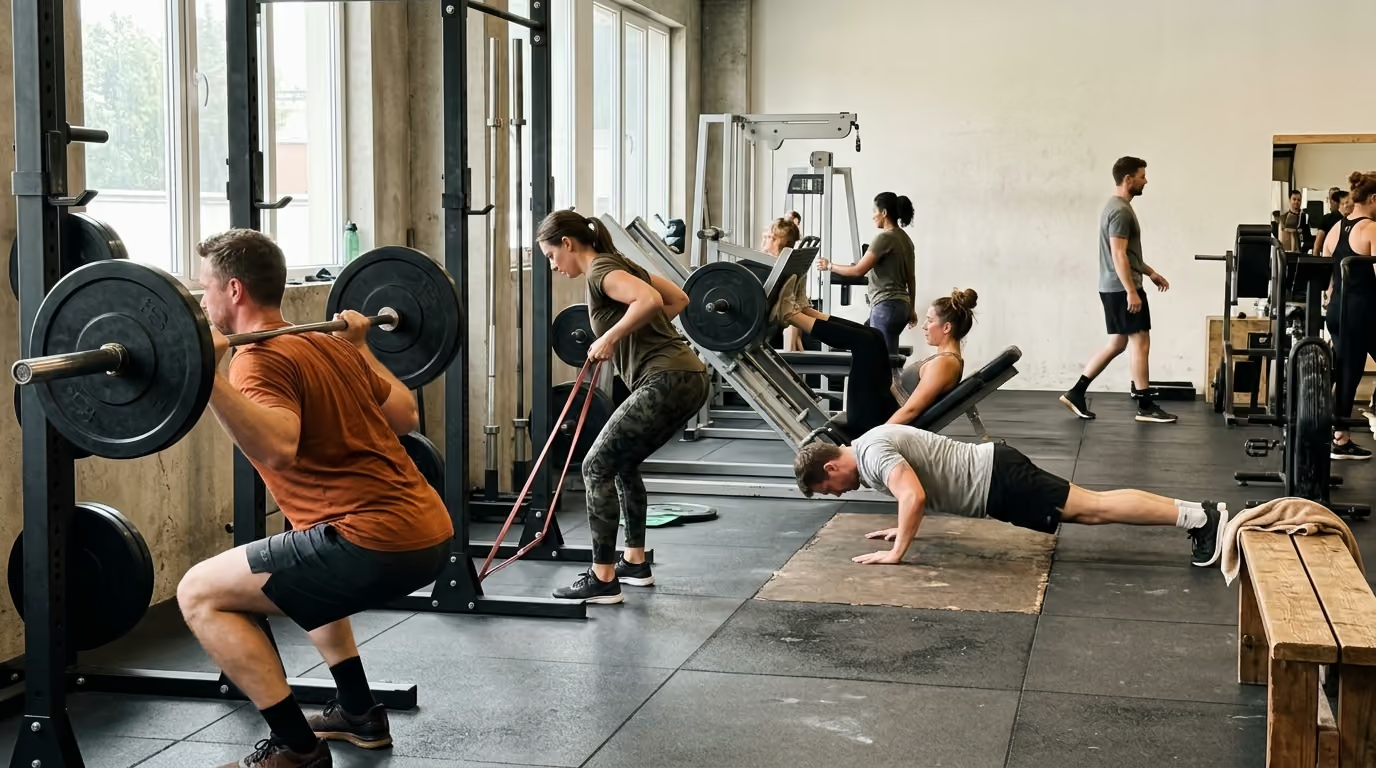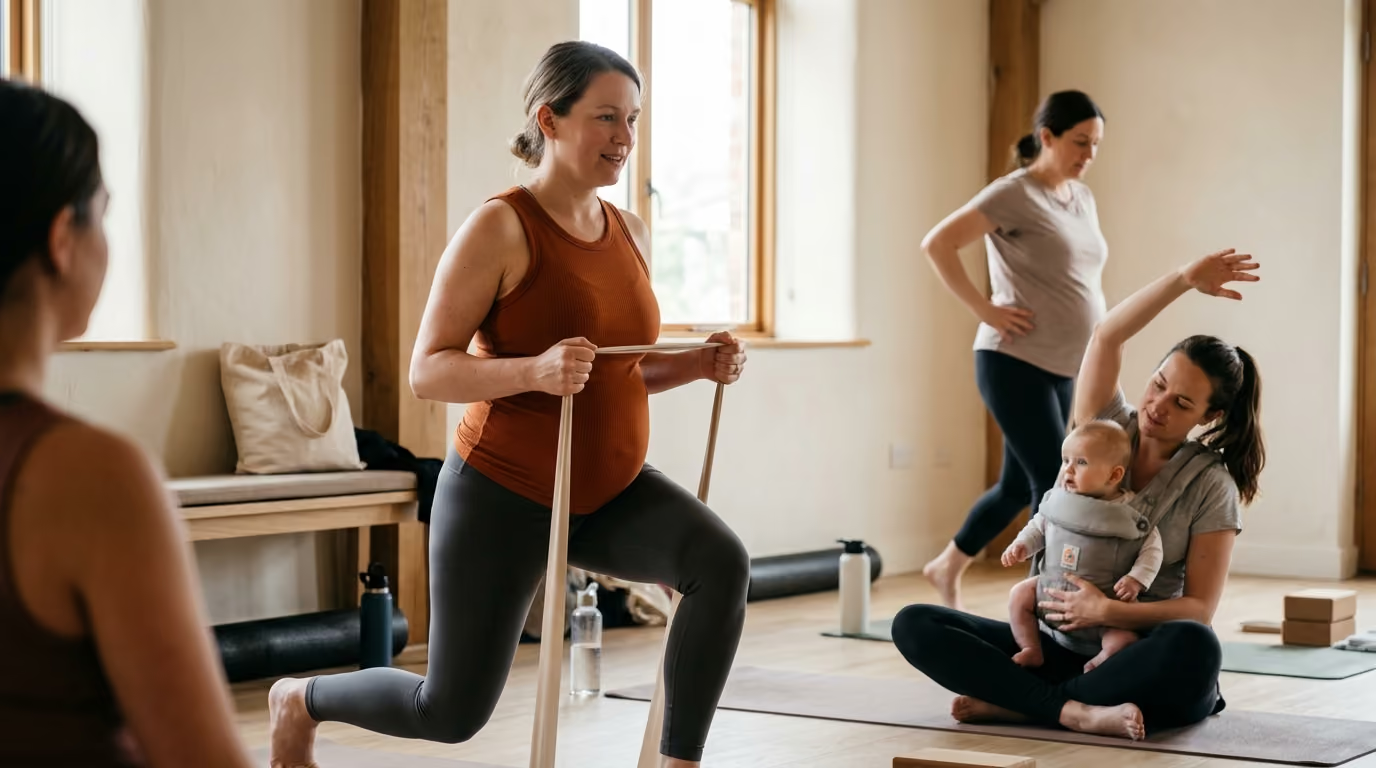

A resilient, stable midsection protects your spine from daily wear and improves total body strength through effective trunk bracing techniques.





You finish a set of fifty floor crunches, stand up to pick up a loaded laundry basket, and immediately feel an uncomfortable twinge in your lower back. It is a frustrating and common experience. Many adults spend years doing traditional abdominal exercises, yet they still struggle with back fatigue during everyday lifting and carrying.
True core strength is not about bending your spine over and over again on an exercise mat. Biomechanically, your trunk acts as a bridge that stabilizes your spine, protects your lower back, and transfers energy between your lower and upper body. Building a resilient midsection requires learning how to brace, resist unwanted movement, and maintain structural control under load.
Understanding how to train these movement patterns allows you to build real-world physical capability without extreme routines or spine-stressing volume. When you support your training with adequate nutrition, intelligent movement, and proper sleep and recovery strategies, you build a foundation that protects your joints for decades.
In fitness culture, the word core is often treated as a synonym for the rectus abdominis, the visible muscle responsible for the traditional six-pack look. In biomechanics and sports science, researchers define core stability quite differently. Core stability is the capacity of your neuromuscular system to maintain the position of the trunk over the pelvis while forces are produced, controlled, and transferred across the body.
This means your trunk muscles are primarily designed to prevent unwanted movement rather than initiate large amounts of spinal flexion. When you walk, run, push an object, or lift a heavy box from the floor, your extremities generate force against the ground. If your midsection is loose or unstable, that force dissipates, placing excessive strain on the lumbar vertebrae and surrounding ligaments.
The trunk consists of several interconnected muscle groups working together as a single functional unit. Sports scientists categorize these into local stabilizing muscles and larger core-limb transfer muscles:
These muscles work in harmony to control posture. Rather than moving the spine through extreme ranges of motion, their primary job during daily activities is resisting excessive spinal extension, unwanted twisting, and lateral bending.
This mechanism is often called force transfer. When you perform a physical action like throwing a ball or swinging a golf club, the power starts in your feet and hips. A stable trunk acts like a solid pillar, allowing that power to travel cleanly into your arms and hands. If your midsection lacks stability, energy leaks out through the torso, reducing physical performance and increasing joint wear.
To protect the spine during movement, your body relies on two primary biomechanical mechanisms: intra-abdominal pressure and muscle co-contraction. Together, these mechanisms create trunk stiffness, which locks the lumbar spine in a safe, strong position.
Muscle co-contraction occurs when muscles on opposite sides of your torso contract at the same time. For example, your abdominal wall contracts at the same time as your spinal extensors in your back. Biomechanical research shows that increasing muscle co-activation from minimal to maximal levels can increase overall trunk stiffness by nearly thirty-eight percent.
This co-contraction is especially critical in asymmetric postures, such as when you carry an uneven load or balance on one leg. When your body is tilted or unevenly loaded, your nervous system must increase muscular tension across opposing muscle groups to prevent the spine from buckling.
However, spinal stiffness comes with a physiological trade-off. When opposing muscles contract strongly together, they compress the spinal column. Biomechanical modeling research demonstrates that antagonistic co-contraction can account for up to forty-seven percent of the total compressive load placed on the spine. During forward flexion tasks, compression can be nearly fifty percent greater than during extension tasks despite similar levels of trunk effort.
Because of this compressive cost, the goal of core training is not to walk around with maximal abdominal rigidity all day long. Continuous, maximum tension places unnecessary wear on the lumbar discs. The true objective of trunk training is task-appropriate stiffness. You want the ability to generate light tension when walking, moderate tension when carrying a suitcase, and high tension when lifting a heavy barbell.
The second component of stability is intra-abdominal pressure. When your diaphragm contracts downward and your abdominal wall resists that downward push, pressure rises inside your abdominal cavity. Research shows that increasing intra-abdominal pressure through diaphragm stimulation increases lumbar spine stiffness between eight and thirty-one percent above resting levels. This pressure acts like an internal hydraulic cushion, supporting the anterior side of your spine from the inside out.
For many years, physical therapy and fitness instruction promoted abdominal hollowing, often described as sucking your belly button in toward your spine. The theory was that pulling the navel inward would isolate and activate the deep transversus abdominis muscle.
Modern biomechanical research has shown that abdominal bracing is far superior to hollowing when the goal is resisting external loads and stabilizing the spine. Abdominal bracing involves contracting the entire abdominal wall, back extensors, and obliques simultaneously, as if preparing to take a light punch to the stomach.
In a laboratory study comparing the two techniques, researchers measured both intra-abdominal pressure and muscle activation across multiple muscle groups. Peak changes in intra-abdominal pressure averaged over one hundred and sixteen millimeters of mercury during abdominal bracing. In contrast, intra-abdominal pressure changes averaged under ten millimeters of mercury during abdominal hollowing.
The same study confirmed that bracing produced significantly higher electrical activity in the rectus abdominis, external obliques, internal obliques, and erector spinae compared to hollowing. Sucking the stomach inward actually reduces the base of support of the torso, decreasing overall stability. Bracing expands the torso slightly in all directions, creating a rigid cylinder around the spine.
Proper bracing does not require you to hold your breath continuously. During heavy, maximal lifting efforts, a brief breath hold known as the Valsalva maneuver helps maximize intra-abdominal pressure. For general strength training and daily tasks, you should learn to maintain moderate abdominal wall tension while breathing in and out smoothly through your nose and mouth.
To practice basic bracing, place your thumbs on your sides just above your hips and wrap your fingers around your lower abdomen. Take a deep breath into your lower belly, feeling your sides expand outward into your thumbs. Gently tighten your midsection as if clearing your throat, maintaining that muscular firmness while continuing to take shallow, controlled breaths.
To build functional midsection strength that protects your body during daily movement, you need to train your trunk to resist movement across multiple planes. Rather than relying on crunches, a comprehensive trunk routine should be built around four primary movement categories: anti-extension, anti-rotation, anti-lateral flexion, and loaded carries. You can read more about foundational movement patterns in our guide to strength and fitness principles.
Anti-extension exercises challenge your trunk to prevent your lower back from arching excessively when your arms or legs move away from your body. When you reach overhead or extend your legs, gravity and external resistance pull your lumbar spine into extension. Anti-extension strength keeps your rib cage aligned over your pelvis, preventing your lower back from taking the brunt of the load.
Common anti-extension exercises include:
During anti-extension drills, proper alignment is essential. The exercise is only successful if you can move your limbs without letting your ribs flare upward or your lower back arch off the floor. If your back arches, the abdominal muscles have lost control of the position, and the exercise should be modified to a shorter lever arm.
Anti-rotation exercises train your torso to resist twisting forces. In everyday life, you often have to hold objects in front of you while forces pull your body to one side, such as opening a heavy door or walking a dog on a leash. Anti-rotation drills build the oblique and deep spinal strength required to keep your hips and shoulders square under asymmetric tension.
The primary exercise in this category is the Pallof press, named after physical therapist John Pallof. To perform a Pallof press:
You can perform the Pallof press in a standing position, a half-kneeling position with one knee on the floor, or a tall-kneeling position. The half-kneeling variation is particularly valuable because it removes the ability to compensate with your lower legs, forcing the glutes and abdominal wall to control rotation entirely.
Anti-lateral flexion exercises challenge your trunk to resist bending sideways under an uneven load. Whenever you carry a heavy shopping bag in one hand, your torso naturally wants to lean toward the loaded side or overcompensate by leaning far in the opposite direction. Anti-lateral flexion training strengthens the quadratus lumborum, obliques, and lateral hip muscles to keep your spine vertical.
A systematic review examining fifteen studies and over twelve hundred participants found that targeted trunk training produced moderate to large improvements in lateral trunk-flexion endurance. Building lateral endurance ensures your spine remains stable during asymmetric lifting and long walks with offset loads.
Practical anti-lateral flexion exercises include:
Loaded carries represent one of the most functional forms of trunk training available. Carries combine active bracing, dynamic hip stability, and gait mechanics under real-world loads. When you walk while holding weights, your trunk muscles must constantly adjust to shifting forces as your feet leave and strike the ground.
Research examining load carriage during locomotion shows that walking with weight significantly increases muscular activity throughout the cervical, thoracic, and lumbar regions of the erector spinae. Furthermore, biomechanical studies show that even modest external loads, such as a pack equal to ten percent of body weight, meaningfully alter muscle activation and lumbosacral loading patterns.
You can incorporate several variations of loaded carries into your routine:
To perform carries safely, select a weight that allows you to walk with a natural stride without swinging your hips or slouching your shoulders forward. Aim for distances between twenty and fifty yards per set, focusing on controlled breathing and full-body tension. You can learn more about structural exercise programming within our movement and body composition library.
While targeted drills like planks and Pallof presses are effective for teaching motor control, the trunk does not operate in isolation during complex physical tasks. Full-body compound movements demand significant trunk stiffness and serve as powerful tools for developing midsection stability.
When you perform a back squat, barbell deadlift, standing overhead press, or heavy bent-over row, your trunk muscles must generate substantial co-contraction to prevent your spine from collapsing under the load. In a heavy deadlift, your lats, abdominal wall, and spinal extensors work together to form a rigid structural bridge between your hips and your hands.
However, relying exclusively on compound lifts for trunk training has limitations. In many multi-joint exercises, the prime movers, such as the quadriceps or hamstrings, may fatigue before the trunk muscles receive an optimal training stimulus. Additionally, compound lifts are largely bilateral and symmetrical, meaning they do not challenge anti-rotational or anti-lateral flexion capacities as intensely as unilateral carries or Pallof variations.
A complete training program combines both approaches. Compound lifts provide heavy, integrated loading across the entire muscular system, while targeted anti-movement exercises address specific stability weaknesses and unilateral imbalances.
To integrate trunk training into your current routine, you can use targeted core exercises in three distinct ways:
When evaluating core training, it is important to separate scientific evidence from commercial fitness marketing. The research demonstrates clear benefits for specific physical attributes, while showing more modest effects for others.
A common claim in the fitness industry is that weak abdominal muscles cause lower back pain and that strengthening the core will instantly cure back discomfort. The clinical research paints a much more nuanced picture.
A comprehensive systematic review and meta-analysis published in the spine literature found that specific core-stabilization exercises provided only minimal short-term and medium-term benefits compared with general exercise for low-back pain and functional disability. Subsequent reviews have found that while core-stability training is effective for reducing pain and improving function in people with chronic non-specific low-back pain, it is often no more effective than other well-designed progressive exercise programs, such as general resistance training or walking.
Core exercises can be an excellent component of a rehabilitation plan, but they are not a magical cure. Back health depends on movement variety, total daily physical activity, hip mobility, stress management, and sensible loading habits. You can find more evidence-led strategies for managing physical well-being across our weight management and health resources.
The strongest scientific evidence supporting trunk training relates to muscular endurance. A meta-analysis of fifteen studies showed that systematic core training produces robust improvements in trunk flexion endurance and large improvements in both right and left lateral flexion endurance.
Muscular endurance in the trunk is often more protective than maximal strength. During daily life and athletic tasks, your core muscles must work continuously at low levels of tension for hours at a time. Improving trunk endurance ensures that your postural muscles do not fatigue prematurely, preventing your spine from slipping into compromised alignments when you get tired.
A 2025 systematic review of competitive athletes confirmed that structured core programs reliably improve trunk-extensor strength, core endurance, dynamic balance, and straight-line sprint speed. However, the same review found that evidence for improvements in maximal trunk-flexor strength, vertical jump height, and agility drills was far less conclusive.
The evidence regarding athletic performance shows positive but task-specific results. A 2023 systematic review and meta-analysis reported that core training produced measurable improvements in balance, jumping distance, and throwing distance in athletic populations. The reported effect size for balance was 1.17, and the effect size for throwing distance reached 3.42.
However, the same meta-analysis found no statistically significant improvement in throwing or hitting velocity, reporting a small effect size of 0.30 that did not reach statistical significance. This distinction is critical. Core stability helps an athlete maintain balance and transfer force through gross movement patterns, but it does not automatically increase the maximum speed of a limb in complex, high-velocity sports skills.
Core training builds the structural capacity to support athletic movement, but it cannot replace the sport-specific skill practice required for high-velocity throwing or swinging.
Misunderstandings about trunk training remain widespread in gym settings. Clearing up these misconceptions will save you time and prevent unnecessary joint stress.
The classic floor crunch trains only one movement pattern: spinal flexion. While spinal flexion is a natural movement that the spine can safely perform, doing hundreds of crunches daily does little to improve your functional stability.
Crunches place repeated compressive and bending loads on the lumbar spine without teaching the trunk how to resist unwanted forces while standing or carrying. Replacing high-rep crunches with anti-extension and loaded carry exercises trains the trunk in the manner it actually functions during daily life.
The idea that you must suck your stomach inward to protect your spine during lifting remains common, but biomechanical testing has thoroughly disproven it. As discussed earlier, abdominal hollowing dramatically reduces intra-abdominal pressure and drops muscular activation across your obliques and back extensors.
When you lift an external load, you should use abdominal bracing. Expand your abdominal wall outward slightly against your belt or waistband and create full-circumference tension around your midsection.
It is impossible to spot-reduce body fat from your stomach by performing abdominal exercises. When your body mobilizes stored fat for energy, it draws fat systemically from across your entire body based on genetics, hormonal factors, and overall energy balance.
Changes in body composition depend on a sustainable combination of total daily movement, resistance training, and consistent nutritional habits. Core training strengthens the underlying muscles of your trunk, but it will not selectively remove subcutaneous fat from your waistline. You can read more about sustainable body composition principles in our metabolic and lifestyle articles.
While the biomechanics of trunk stability are well documented, several important limitations exist within the current scientific literature.
First, there is no universally accepted industry benchmark or standardized test for core strength in the general population. In research studies, scientists use different tests to measure core function, including timed plank holds, electromyography, isokinetic dynamometry, and balance tests. Because these testing protocols vary widely between studies, researchers cannot easily compare results across different trials or establish a single normal score for healthy adults.
Second, there is a lack of high-quality head-to-head research comparing specific exercises within the same category. While we know that anti-extension exercises increase trunk stiffness, no long-term clinical trials prove that the ab wheel rollout is superior to the dead bug for injury prevention or athletic development. Exercise selection should be guided by individual mobility, tolerance, and current strength levels rather than rigid rules.
Finally, trunk stability research often uses small sample sizes of young, athletic individuals. The biomechanical demands and spinal tolerances of an elite twenty-year-old athlete differ significantly from those of a fifty-year-old adult returning to exercise after a sedentary period. Older adults should progress gradually, prioritizing movement quality and joint comfort over maximal loads.
Understanding basic biomechanical vocabulary helps you make sense of training guidelines and scientific literature:
Building a stable, resilient trunk does not require hours of complex training. You can establish a complete core training routine by following a simple, progressive framework:
Revisit this guide whenever you update your strength training routine, experience plateaus in your compound lifts, or need to troubleshoot your form on loaded carries. Building a strong, stable trunk is a lifelong practice of developing coordination, balance, and controlled tension that supports every movement you make.
WeightRestart shares research-led guidance on weight loss, metabolism, nutrition, strength, appetite, sleep and recovery. Our goal is to make complex health information clear, practical and useful for people building progress they can maintain.



Learn how to build a weight-management approach around better information, realistic expectations and habits you can keep using.
read the blog