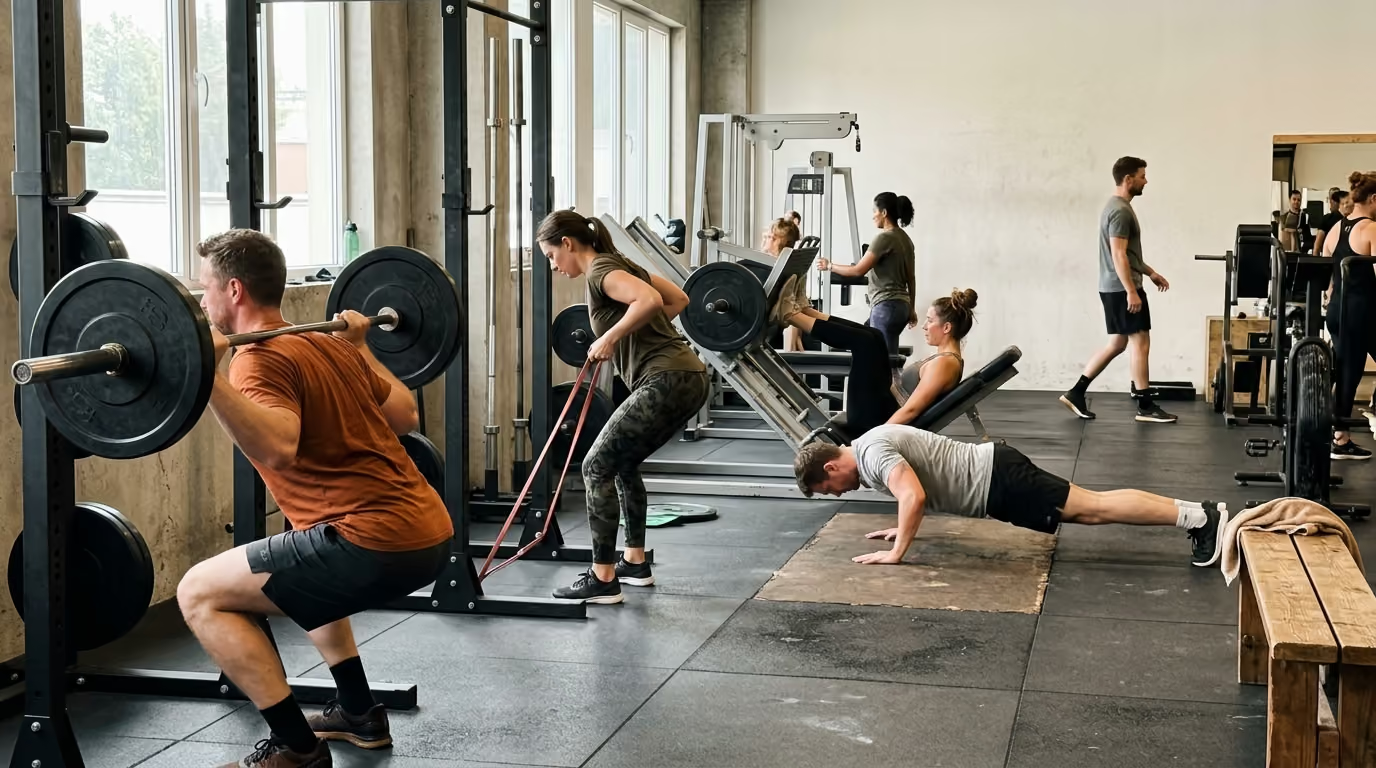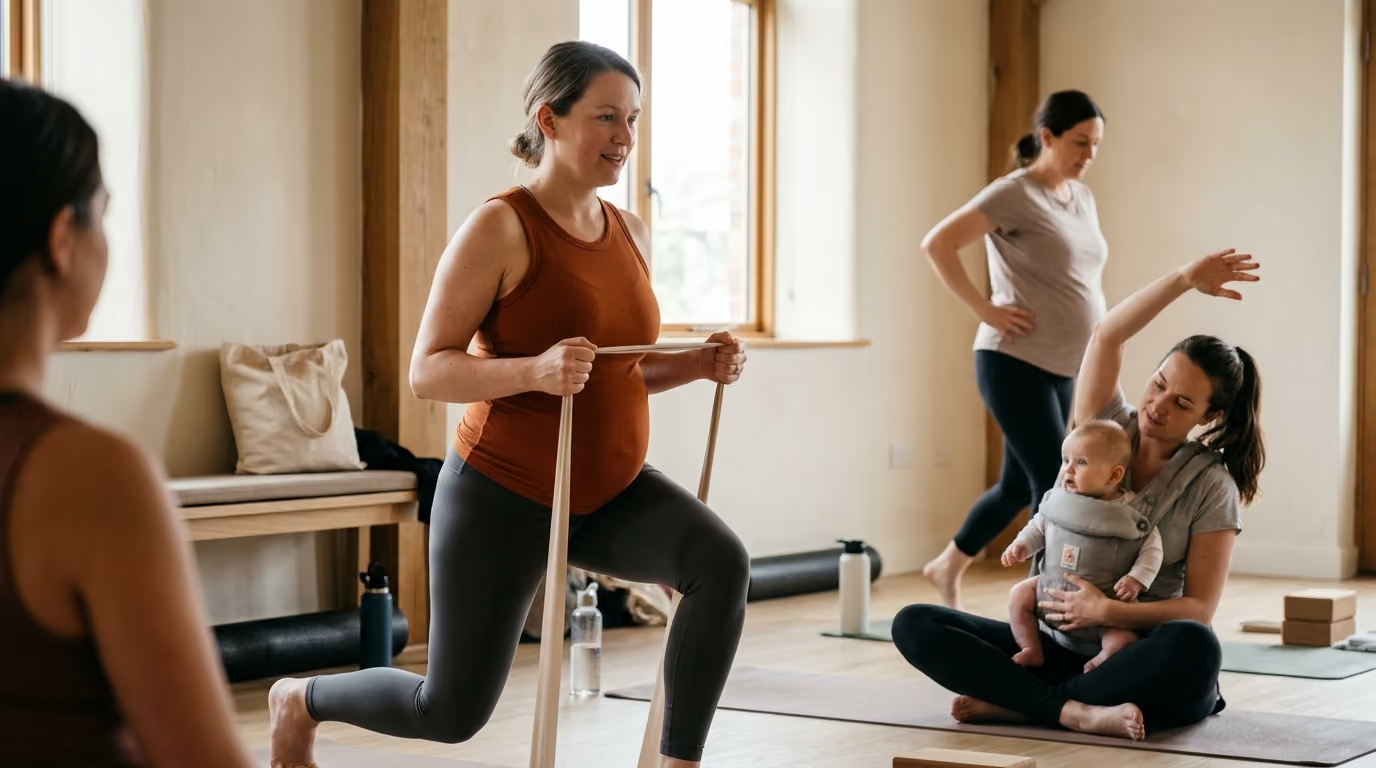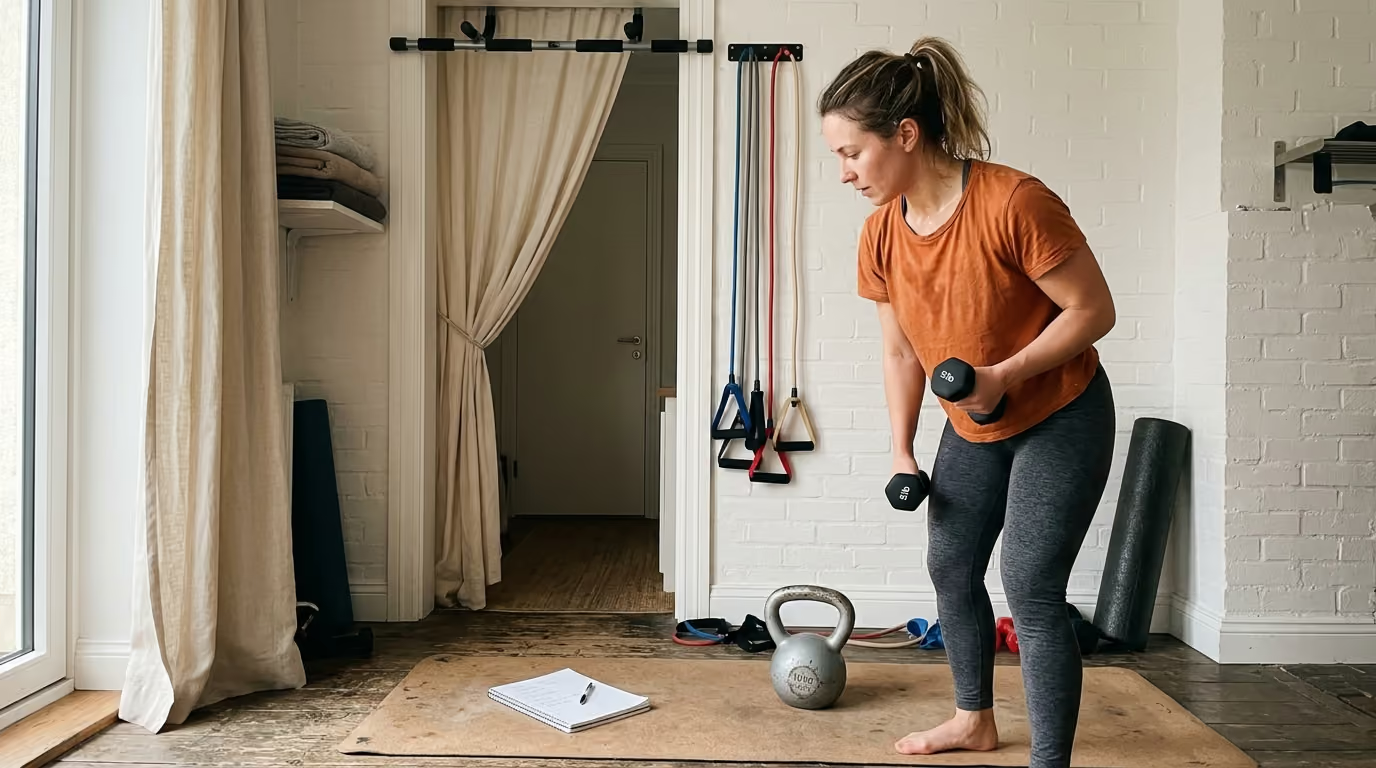

Setting up a small workout space requires evaluating dumbbells, bands, kettlebells, and bodyweight tools to match specific strength and physique goals.





Many people believe that building muscle or protecting metabolic health requires an expensive commercial gym membership filled with specialized barbells and heavy iron plates. This assumption causes many adults to abandon strength training altogether when time or space is limited. The human muscular system does not recognize whether tension comes from a five-thousand-dollar machine, an adjustable dumbbell, an elastic strip of latex, or body weight. Muscles only recognize mechanical tension, the degree of motor unit recruitment, and the metabolic stress created by consistent effort.
An effective home strength program depends entirely on whether your setup allows you to apply sufficient resistance across major movement patterns, progress that resistance over time, and recover properly. Research from the American College of Sports Medicine confirms that nontraditional training modalities, including elastic resistance bands and home body-weight routines, produce meaningful improvements in muscular strength, hypertrophy, and physical function. Selecting the right equipment is not about finding a single perfect tool. It is about matching your specific living space, budget, and physical goals to the right mechanical resistance.
Understanding how different equipment options function allows you to build an effective training program in a living room, garage, or hotel room. When you view equipment as a simple delivery mechanism for muscular tension, you can train consistently regardless of your physical environment.
(Visualizing equipment choices by matching individual goals, available space, and budget against loading profiles.)
Skeletal muscle tissue adapts to external physical demands through a process called mechanotransduction. When muscle fibers contract against an external load, mechanical sensors located within the muscle cell membranes convert physical force into intracellular chemical signals. These chemical cascades activate the mammalian target of rapamycin pathway, which increases muscle protein synthesis. When muscle protein synthesis exceeds muscle protein breakdown over time, muscle fibers increase in cross-sectional area.
To stimulate this adaptive pathway, you must recruit high-threshold motor units. According to Henneman's size principle, motor units are recruited in an orderly fashion from smallest to largest based on the magnitude of the demand. Lifting a heavy weight immediately recruits both low-threshold and high-threshold motor units. Lifting a lighter weight recruits high-threshold motor units only as the set approaches muscular fatigue. This biological reality means that lighter equipment, such as resistance bands or body weight, can produce similar muscle growth to heavy free weights if sets are performed with high effort.
Muscular adaptations are driven by training stimulus rather than the brand name or appearance of the equipment. A complete training stimulus requires sufficient mechanical tension, an adequate range of motion, and a progressive challenge over time. If a home tool allows you to perform an exercise through a full range of motion with enough resistance to challenge the target muscle, the biological adaptation will occur.
Managing weekly training volume is essential for sustainable progress. Volume is best measured as the number of challenging sets performed per muscle group each week. For those focusing on sustainable weight management and metabolic health, preserving lean tissue through resistance exercise supports resting energy expenditure, insulin sensitivity, and glucose clearance. The biological stimulus depends on the quality of your movement and effort rather than the complexity of your home setup.
The scientific evidence supporting home-based resistance training is robust and well established across diverse populations. Decades of exercise science literature demonstrate that multiple resistance modalities can stimulate improvements in strength, muscular endurance, and functional mobility. The American College of Sports Medicine updated guidance highlights that nontraditional resistance training, including elastic bands and calisthenics, produces significant physical benefits across the human lifespan.
A comprehensive systematic review and meta-analysis published in the journal Sports Medicine evaluated the differences between free weights and machine-based training. The researchers found that both modalities produce similar increases in muscle hypertrophy and general strength. However, strength gains exhibited testing specificity. Trainees who practiced with free weights performed better on free-weight tests, while those who trained on machines performed better on machine tests. When neutral testing devices were used, the strength differences between the two modalities disappeared.
A separate systematic review examining elastic resistance training demonstrated that resistance bands produce comparable improvements in strength and muscle mass when compared to conventional weight machines and free weights. Elastic resistance challenges the muscle across the movement path, provided the exercise is calibrated to provide sufficient tension at the appropriate joint angles. The World Health Organization physical activity guidelines recommend that all adults perform muscle-strengthening activities involving all major muscle groups on at least two days per week. The scientific literature confirms that this public health standard can be achieved using free weights, elastic resistance, selectorized machines, or body weight.
Choosing the right equipment requires an understanding of how each tool provides resistance. Every modality has distinct physical characteristics, mechanical advantages, and practical limitations.
Dumbbells represent the most versatile free-weight option for home training environments. They allow each limb to work independently, which helps identify and correct strength asymmetries between your left and right sides. Dumbbells also permit natural rotation of the wrists and shoulders during pressing and pulling movements, reducing unnecessary stress on sensitive joints.
Adjustable dumbbell sets provide a wide range of resistance increments while occupying only a few square feet of floor space. Unilateral exercises, such as single-arm dumbbell rows and split squats, allow you to create high muscular tension without needing extremely heavy weights. The primary limitation of dumbbells is the financial cost of heavier pairs and the eventual ceiling on absolute load for bilateral lower-body exercises like conventional deadlifts.
Resistance bands are lightweight, portable, and inexpensive, making them an exceptional choice for small apartments and frequent travelers. Unlike free weights, which rely on gravity for downward resistance, bands provide tension based on how far the material is stretched. This allows you to apply resistance in horizontal, diagonal, and rotational directions that gravity cannot duplicate without a pulley system.
The variable resistance curve of elastic bands means that an exercise feels easiest at the beginning of the movement and hardest at peak contraction. This property can be advantageous for joint comfort, but it makes tracking precise workload numbers more difficult. Securing bands to sturdy anchor points is essential for safety, as band slippage or material failure can cause sudden recoil.
Kettlebells feature a displaced center of mass, with the weight positioned several inches below the handle. This unique geometry challenges grip strength, core stability, and shoulder control far more than a standard dumbbell. Kettlebells are particularly effective for dynamic, hip-hinge movements such as swings, cleans, and snatches, which develop lower-body power and physical conditioning simultaneously.
While kettlebells are excellent for full-body compound exercises and loaded carries, their fixed-weight design makes micro-progressions difficult. Jumping from a sixteen-kilogram kettlebell to a twenty-kilogram kettlebell represents a twenty-five percent increase in load, which may be too large for upper-body isolation exercises. Kettlebell training also requires dedicated time to master technical movement mechanics safely.
Home weight machines and compact cable systems provide external stability by guiding the resistance along a fixed or semi-fixed track. This external support allows you to focus purely on muscular effort without spending energy on balancing the weight. Cable machines provide continuous, smooth tension throughout the entire range of motion, making them effective for muscle isolation and hypertrophy.
The main drawbacks of home machines are their high financial expense, large spatial footprint, and complex assembly requirements. A machine designed for a single movement pattern takes up valuable room that could otherwise accommodate versatile free weights. Compact functional trainers with adjustable dual pulleys offer greater flexibility, but they still require a dedicated workout area.
Body-weight training, or calisthenics, requires zero financial investment and can be performed in any space large enough to lie down. Calisthenics develops relative body strength, spatial awareness, and joint control by using your own mass as the primary resistance. Movements like push-ups, dips, lunges, and body-weight squats form the foundation of human movement competence.
The primary challenge of body-weight training is progressive overload, especially for the pulling muscles of the upper back and the heavy prime movers of the lower body. Progressing a body-weight exercise requires manipulating leverage, limb elevation, or tempo rather than simply adding weight plates. Incorporating an inexpensive doorway pull-up bar or suspension trainer solves the pulling deficit and significantly expands body-weight exercise options.
To build an effective home routine, match your equipment choices to your primary training outcome and your physical living environment.
If your primary objective is maximal force production, prioritize tools that allow heavy, measurable, and incrementally progressive loading. Adjustable dumbbells with high weight capacities and heavy kettlebells provide the necessary mechanical tension to challenge neuromuscular recruitment. ACSM guidelines recommend using loads around eighty percent of your one-repetition maximum for strength-focused adaptations. Free weights require greater self-stabilization, which translates directly to real-world force application.
If your goal is increasing muscle size, stability and consistent tension are your top priorities. Hypertrophy requires accumulating weekly sets close to muscular failure across a full range of motion. Research shows that machines, dumbbells, and resistance bands produce equivalent muscle growth when sets are matched for effort. Combining adjustable dumbbells with resistance bands allows you to load compound movements heavily while using bands for high-repetition accessory exercises.
For adults interested in metabolic health, bone density, and long-term functional mobility, a minimalist setup is entirely sufficient. The World Health Organization baseline of two full-body strengthening sessions per week can be achieved with a pair of medium-weight dumbbells and an elastic resistance band. This setup provides adequate loading to improve glucose uptake in skeletal muscle, enhance insulin sensitivity, and support daily movement patterns without complex programming.
Power training emphasizes moving moderate resistance with maximum concentric speed. Kettlebells are the premier home tool for this goal, as explosive swings and snatches train the posterior chain to generate rapid hip extension force. Elastic bands can also be used for explosive push presses and band-resisted jumps. Power exercises should always be performed with crisp technique and adequate rest between sets to avoid fatigued, sloppy movement.
Training in an apartment requires equipment that minimizes floor impact, acoustic vibration, and clutter. Avoid dropping heavy weights by selecting exercises that emphasize slow, controlled eccentric lowering phases. Floor presses eliminate the need for a bulky weight bench while protecting your living room floor. Resistance bands, suspension straps, and adjustable dumbbells that store neatly in a closet provide a complete training stimulus without damaging rented living spaces.
For more guidance on selecting movement patterns that fit your daily schedule, review our resource on evidence-based strength programming frameworks.
Progressive overload is the fundamental law of resistance training. It states that the physical demand placed on the muscular system must gradually increase over time to drive continuous adaptation. In a traditional commercial gym, progression is achieved by adding small weight plates to a barbell. In a home gym with limited equipment, you must use alternative, highly effective methods to increase training difficulty.
The double-progression model is the most practical framework for home trainees using fixed or adjustable dumbbells. Instead of trying to add weight every workout, you work within a target repetition range, such as eight to twelve repetitions. You begin with a weight you can lift for eight clean repetitions. Over subsequent sessions, you keep the load identical and focus on adding repetitions until you can perform twelve controlled repetitions across all prescribed sets. Only then do you increase the resistance to the next available increment and return to the lower end of the repetition range.
Because testing a true one-repetition maximum is impractical and unsafe in a home setting, effort-based tracking provides a reliable alternative. Repetitions in Reserve, abbreviated as RIR, measures how many additional, technically sound repetitions you could have performed before reaching muscular failure.
For most productive working sets, aim to finish your exercises with one to two repetitions in reserve. This ensures that the set provides a sufficient biological stimulus to recruit high-threshold motor units without creating excessive systemic fatigue or risking technical failure.
When training with body weight or fixed-increment resistance bands, you can increase difficulty without adding external load by modifying your movement biomechanics:
By systematically manipulating these variables, a single pair of moderate dumbbells or an elastic band can challenge your muscular system for months before you ever need heavier equipment.
An effective home strength program must cover all primary human movement patterns to ensure balanced joint development and prevent overuse injuries. A complete program trains the following foundational patterns:
Selecting a weekly schedule depends on your lifestyle, available recovery capacity, and daily schedule. Consistency and weekly volume matter far more than following a rigid split.
This schedule is ideal for busy adults looking to meet health guidelines with maximum efficiency. Allow at least forty-eight to seventy-two hours of recovery between sessions.
This structure distributes weekly volume across three manageable forty-five-minute sessions, training movement patterns with alternating emphasis.
If you prefer shorter, thirty-minute workouts performed more frequently throughout the week, an upper and lower body split provides excellent recovery between muscle groups.
To ensure adequate recovery between sessions, explore our research-backed guides on sleep and physical recovery strategies.
Navigating home resistance training requires separating evidence-based exercise mechanics from marketing claims. Trainees frequently encounter several common misconceptions.
A common belief is that free weights are universally superior to machines and cables for all fitness goals. While free weights require more self-stabilization, systematic reviews confirm that machines produce identical muscle hypertrophy. If you are training around a balance limitation or joint injury, a supported machine or cable exercise can safely isolate a muscle group without putting excessive stress on connective tissues.
Some fitness enthusiasts claim that resistance bands are only useful for warm-ups or physical therapy. Peer-reviewed research demonstrates that elastic resistance produces comparable muscle hypertrophy to traditional free weights when sets are performed with high effort near muscular failure. As long as the band provides sufficient tension through a complete range of motion, the muscle cell adapts identically.
Because home workouts often use lighter weights, trainees sometimes assume every single set must be taken to absolute muscular failure. Regularly training to complete failure creates excessive central nervous system fatigue, prolongs recovery times, and increases the likelihood of technical breakdown. Stopping sets one to two repetitions shy of failure delivers nearly all potential muscle-building stimuli while keeping joint stress manageable and recovery predictable.
Many people mistakenly believe that buying more equipment will automatically improve their training consistency. Purchasing multiple specialty bars, benches, and machines often leads to cluttered living spaces and decision fatigue. A simple setup consisting of one versatile tool used with progressive discipline yields far better long-term results than an underutilized room full of expensive gear.
While home strength training is accessible and safe, it is important to recognize practical boundaries, environmental hazards, and individual health limitations.
Training alone at home requires intentional risk management. Never perform heavy barbell bench presses at home without safety spotter arms, and never clamp barbell collars on a solo bench press so plates can slide off if you become pinned. When using resistance bands, inspect the material regularly for small tears, nicks, or thinning. Always attach band door anchors on the side of a door that pulls the door shut against the doorframe rather than pulling it open.
If an exercise causes sharp joint pain, do not attempt to push through the discomfort. Pain alters motor recruitment patterns and can lead to compensatory movement injuries. Instead of abandoning the movement pattern entirely, modify the joint angle, adjust your grip orientation, reduce the range of motion slightly, or slow the eccentric tempo. For example, switching from a flat barbell press to a neutral-grip dumbbell floor press often resolves front shoulder irritation immediately.
The physical activity recommendations outlined in this guide apply to generally healthy adults. Older adults or individuals with existing cardiovascular conditions, osteoporosis, severe osteoarthritis, or balance impairments should seek guidance from a qualified physical therapist or medical professional before starting an unsupervised home program. Strength training should be individualized to accommodate joint replacements, spinal disc issues, or metabolic conditions. Learn more about the physiological principles of training in our metabolic and weight science archive.
To help you navigate your training program, here are clear definitions for important exercise science terms:
Building an effective strength training program at home does not require a commercial gym setup or complicated gear. When you apply the fundamental principles of progressive overload, balanced movement patterns, and consistent effort, you can build a resilient, healthy body in any space you have available.
WeightRestart shares research-led guidance on weight loss, metabolism, nutrition, strength, appetite, sleep and recovery. Our goal is to make complex health information clear, practical and useful for people building progress they can maintain.



Learn how to build a weight-management approach around better information, realistic expectations and habits you can keep using.
read the blog