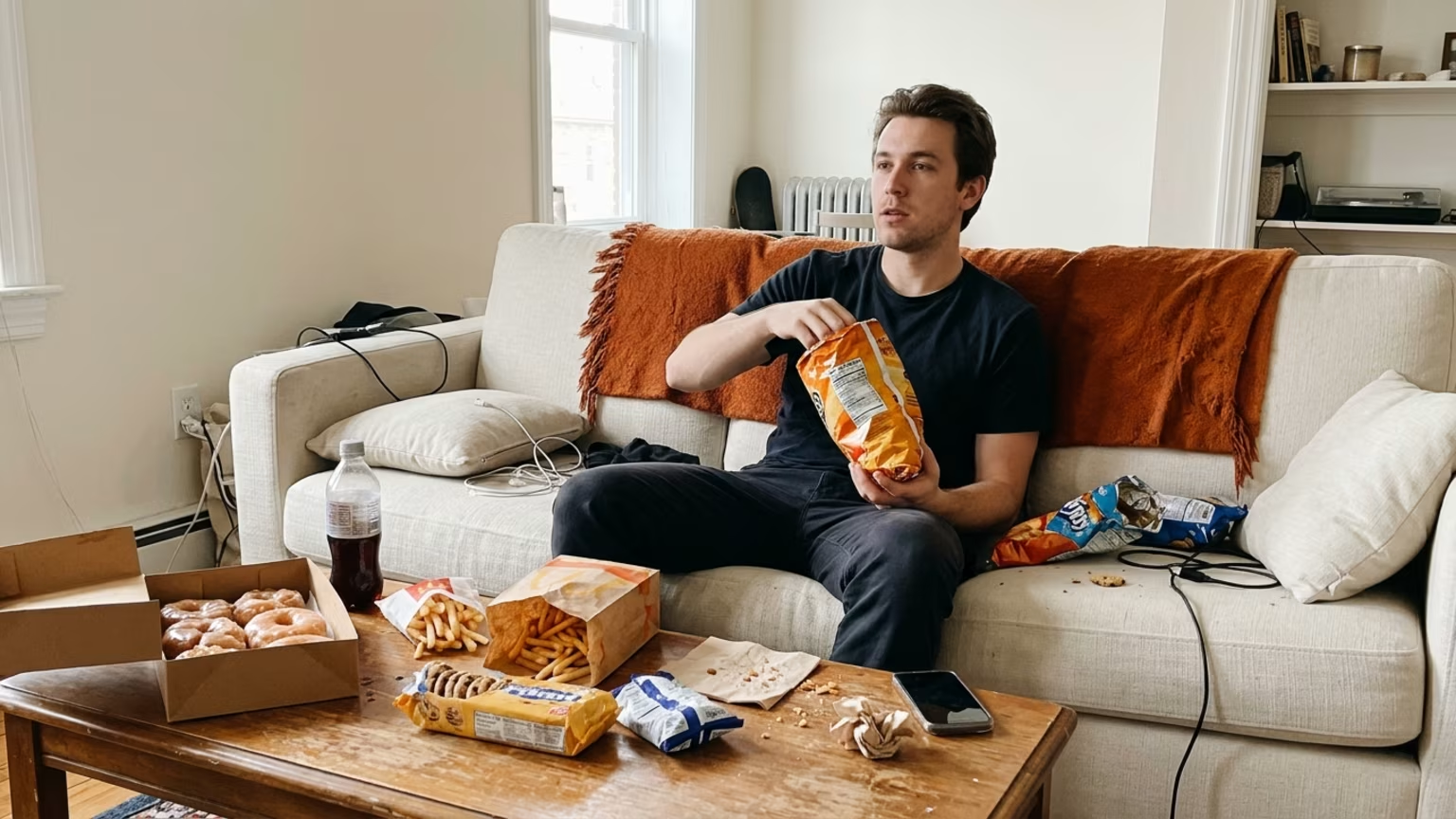

GLP-1 medications help many people manage their weight, but persistent cravings and food noise still affect some patients. Learn the biology behind non-response.





On September 7, 2026, the Guardian published new reporting regarding people who experience little to no meaningful weight loss while taking GLP-1 medications. The publication examined patients who report that persistent cravings and intrusive food thoughts continue despite treatment. These accounts highlight the difficulties individuals face when medication, diet, and exercise efforts do not quiet their appetite.
The article profiled Mercedes, a recently retired Canadian teacher in her 50s. She tried several medications including Ozempic for nine months and Wegovy for four months. She then moved on to Contrave, Mounjaro, and finally Zepbound. Despite these efforts, she stated that intrusive thoughts about food never stopped.
Mercedes reported losing 20 pounds during a month of particularly strict self-directed efforts. However, she attributed this weight loss entirely to her own strict restrictions rather than the medication itself. Lucille, a 53-year-old woman in Luxembourg, shared a similar experience with the publication. She reported that GLP-1 medications initially helped but later stopped producing weight loss after she moved from Saxenda to Ozempic and then to Mounjaro.
As our team at WeightRestart has noted before: "When the new class of weight-loss medications started dominating the news, the media reaction was entirely polarized. It was either a miracle cure or a moral failing."
"I saw a huge need for calm, objective reporting. We decided to cover these medications exactly like any other tool by exploring the clinical data, the benefits and the limitations without any judgment. The response from our readers showed just how starved people were for facts over feelings."
To understand why these treatments do not work for everyone, we must look at how they interact with human biology. Ozempic and Wegovy contain semaglutide, which mimics the GLP-1 hormone. Mounjaro and Zepbound contain tirzepatide, which acts through GLP-1 plus another hormonal pathway. These medications influence the body through multiple different biological routes.
The main effects of GLP-1 medications include slowing gastric emptying, suppressing appetite, and increasing insulin production. These mechanisms are designed to help regulate hunger signals from the brain and the digestive system. However, biological factors can interfere with this intended process in certain individuals. Researchers are still trying to determine exactly why these physiological systems vary so much.
Dr Mahesh Umapathysivam, an endocrinologist and clinical researcher at Adelaide University, suggested several plausible influences on treatment response. He noted that oestrogen and menstrual-cycle timing could plausibly influence how a patient reacts to GLP-1 therapies. He also discussed research into genetic variants affecting the production of the prohormone-processing enzyme PAM. Some of these variants may produce a form of "GLP-1 resistance" where a given amount of the hormone has less physiological effect.
The possible consequences of reduced GLP-1 responsiveness are broad. According to the report, the consequences could include less weight loss and reduced glucose lowering. Patients might also experience less insulin secretion and a reduced slowing of gastric emptying. This biological complexity explains why managing weight involves far more than simply finding the right prescription. It also reinforces how hormonal shifts impact appetite over the long term.
The mainstream media frequently portrays these treatments as universal solutions that always work. When the media does acknowledge treatment failures, the stories often rely on dramatic and highly emotional language. For example, Mercedes compared her persistent cravings to "heroin withdrawal" while noting that the food talk in her mind never ended. While her personal distress is entirely valid, this comparison is a subjective personal experience rather than a documented clinical equivalence.
The actual clinical data presents a much more grounded reality about medication efficacy. Trials cited by the Guardian report indicate that GLP-1 medications produce average weight losses of roughly 15% to 20% of body weight. However, between 9% and one-third of participants lose less than 5% depending on the specific medication and dose. This variance shows that non-response is a normal, documented statistical reality rather than an anomaly.
Professor Alexander Miras, an obesity expert at Ulster University, stressed that poor response is driven by complex biological factors rather than a lack of willpower. He stated that a poor outcome is not necessarily the patient's fault or the drug's fault. If a medication does not reduce a person's hunger and food intake, it is unlikely to produce the intended effect. He noted that biological appetite regulation is far more powerful than simple discipline.
A major focus of current research is understanding persistent, intrusive thoughts about eating. A 2025 expert consensus paper described "food noise" as persistent, unwanted, and distressing food-related thoughts. This emerging definition distinguishes these disruptive thoughts from ordinary hunger or a normal interest in food. Understanding this distinction can help patients measure how treatments influence food noise beyond just the number on a scale.
Safety remains an important part of the conversation around these medications. The Guardian article notes that large clinical trials and dedicated obesity trials have generally found low absolute rates of reported neuropsychiatric adverse events associated with GLP-1 and GLP-1/GIP medicines. Furthermore, the relative risks compared with a placebo are generally modest. Patients should always discuss their individual risks and side effects with a qualified medical provider.
Evaluating the effectiveness of a medical treatment requires looking beyond total body mass. Another patient profiled in the report, a 57-year-old Canadian named Yury K, illustrates this point clearly. Yury reported starting Wegovy at approximately 242 pounds and remaining at approximately 242 pounds after six months. He maintained this weight despite exercising about five days a week and avoiding junk food and fast food.
Despite seeing no change on the scale, Yury did report meaningful health benefits while taking Wegovy. His benefits included reduced appetite, less food noise, and improvements in blood sugar and cholesterol. His experience demonstrates that a medication might produce valuable metabolic effects without producing substantial weight loss for every patient. Patients must often track multiple health markers to get a complete picture of their overall progress.
Genetics also play a documented role in how individuals respond to these therapies. Adam Auton of the 23andMe Research Institute was the senior author of a study involving a genetic variant that affects brain receptors. Carriers of this variant lost approximately 0.76 kilograms more on average than non-carriers. People with two copies of the variant experienced approximately twice that additional effect.
This specific genetic effect accounted for approximately 10% of the weight people with two copies might expect to lose. However, Miras told the Guardian that researchers cannot currently predict accurately in advance who will respond well based on genetics alone. The report identifies age and sex as possible influences alongside type 2 diabetes. Ancestry and hormonal factors are also being studied as potential variables. None of these variables provide a reliable individual prediction for treatment success.
Future clinical research must focus on predicting individual response rates and developing clearer definitions for non-response. Currently, failing to lose 5% of body weight is just a trial endpoint rather than proof that a medication provides no benefit. Clinicians are investigating GLP-1 medications for potential effects on cardiovascular problems, addictions, and fatty liver disease. These studies might eventually explain why physiological reactions vary so widely among individuals.
Patients who experience inadequate results from one medication still have evidence-based alternatives to consider. Miras suggested that discussing a non-GLP-1 medication like Contrave, known as Mysimba in the UK, could be worthwhile. He described this medication as acting in related brain pathways but in a somewhat different manner. The Guardian report also noted that bariatric surgery may remain an option for some people with inadequate medication response.
Importantly, a poor response to GLP-1 drugs does not necessarily predict a poor response to bariatric surgery. Patients facing persistent cravings should work with their medical providers to adjust their strategies without shame or blame. Sustaining results may require combining medical treatment with targeted psychological support and behavioral habits. Long-term metabolic health is a continuous process of observation, adjustment, and sustainable habit formation.
WeightRestart shares research-led guidance on weight loss, metabolism, nutrition, strength, appetite, sleep and recovery. Our goal is to make complex health information clear, practical and useful for people building progress they can maintain.



Learn how to build a weight-management approach around better information, realistic expectations and habits you can keep using.
read the blog